




The Limits of Physical Labs
For centuries, progress in physics has been tied to physical experiments. From Galileo dropping balls from a tower to scientists at CERN firing up the Large Hadron Collider, discovery has required building, breaking, and observing things in the real world.
But this approach has its limits. Building a particle accelerator can cost billions of dollars and take decades. Experiments involving nuclear reactions or high-energy plasma are incredibly dangerous. And some of the most fascinating concepts in physics, like the inside of a black hole or the behaviour of theoretical particles, are simply impossible to recreate on Earth. Scientists have long relied on computer simulations, but these have often been 2D, non-interactive, and difficult to interpret intuitively.
The Tech Trinity: AI, VR, and Simulation
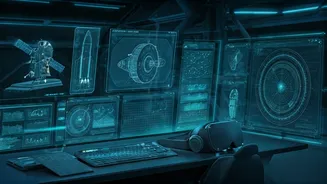
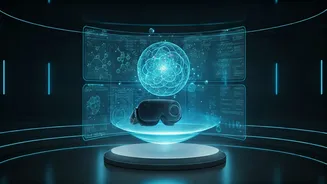
Enter the new paradigm: a powerful combination of three technologies. First, Virtual Reality (VR) provides the immersive, three-dimensional space. Instead of looking at graphs on a screen, a scientist can put on a headset and literally step inside their experiment. Second, Artificial Intelligence (AI) acts as the brain of the simulation. It manages the immensely complex calculations needed to ensure the virtual world obeys the laws of physics. More importantly, AI can interpret a scientist’s actions, predict outcomes, and even suggest new avenues for exploration in real-time. Finally, advanced simulation engines are the heart of the framework, providing the foundational models of the physical world. When these three elements work together, they create a 'digital twin' of a real-world lab, but one without physical constraints.
Step Inside the Virtual Experiment
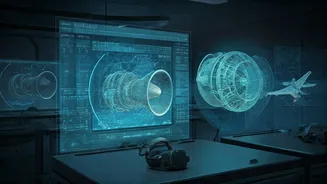
So, what does this look like in practice? A physicist studying fluid dynamics could 'stand' inside a virtual wind tunnel, sculpting the airflows around a new aircraft design with her hands and seeing the turbulence patterns form in real-time. A team of astrophysicists could gather inside a simulation of a binary star system, watching as one star pulls matter from the other, tweaking gravitational constants to see how the interaction changes. Platforms like NVIDIA's Omniverse are already being used to create these photorealistic, physics-abiding virtual worlds. Researchers are using them to simulate everything from factory floor robotics to complex climate models. The key is interactivity. It’s the difference between watching a movie of an experiment and being a character inside it, able to change the plot.
Safer, Cheaper, and Limitless Discovery
The benefits of this approach are transformative. The most obvious is safety. Nuclear engineers can test reactor meltdown scenarios without any real-world risk. The second is cost. Instead of building countless expensive prototypes, an automotive company can crash thousands of virtual cars to perfect a new safety feature. But the most exciting benefit is the expansion of what is possible. Scientists can finally build intuitive models for abstract concepts they have only ever described with mathematics. Imagine a student learning quantum mechanics not from a textbook, but by manipulating a 'probability wave' in VR and watching it collapse into a particle. This technology allows us to explore the theoretical and the impossible, accelerating the pace of discovery.
What This Means for India
For a nation with ambitious goals in space exploration, nuclear energy, and fundamental science, this technology is a game-changer. Institutions like ISRO, BARC, and the network of IITs can leverage these virtual labs to leapfrog traditional research and development cycles. It can drastically cut down the cost and time required to design complex systems, from satellite components to next-generation nuclear reactors. Furthermore, it represents a massive opportunity for STEM education. By providing students with interactive, engaging virtual labs, we can cultivate a deeper, more intuitive understanding of complex scientific principles, inspiring a new generation of innovators and researchers who are fluent in the tools of 21st-century science.