




The Ten-Year Horizon
Dario Amodei, the CEO of prominent AI firm Anthropic, recently made the audacious prediction that artificial intelligence could lead to cures for major diseases like cancer in less than a decade. In a video released by the company, he suggested that conditions
that have challenged medical science for centuries might soon be solvable problems, ushering in an 'age of miracles'. This isn't a one-off statement; Amodei and other tech leaders, like Google DeepMind's Demis Hassabis, have consistently argued that AI's ability to process vast amounts of data will fundamentally change biological research. The core belief is that AI can dramatically speed up the entire pipeline of medical discovery, from forming a hypothesis to designing a drug.
How AI Is Rewriting Drug Discovery
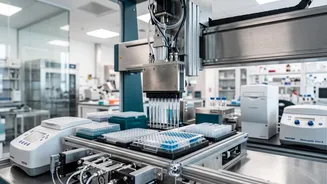
Traditionally, finding a new drug is a decade-plus process costing billions. AI promises to compress this timeline. By analysing complex biological data, AI models can identify novel targets on cancer cells that were previously considered 'undruggable'. Technologies like DeepMind's AlphaFold, which can predict the 3D structure of proteins, allow scientists to simulate how a potential drug might work before ever stepping into a lab. This accelerates the screening of millions of potential compounds, identifying the most promising candidates much faster than human researchers could alone. Furthermore, AI is crucial for personalising medicine by identifying biomarkers in a patient's specific tumour, making it possible to match them with the most effective treatment.
From Future Promise to Current Practice
While a definitive 'cure' remains on the horizon, AI is already making a tangible impact in oncology today. AI-assisted mammography has been shown to detect more cancers than standard screening methods, improving early diagnosis, which is critical for survival. In clinical trials, AI algorithms are helping to match patients with the right studies more efficiently. Researchers are also using AI to analyse pathology slides and CT scans to find subtle signals of cancer that the human eye might miss, as seen in trials for early pancreatic cancer detection. These are not grand cures but incremental, vital gains that are freeing up clinician time, improving diagnostic accuracy, and personalising patient care right now.
The Sobering Reality of Biology
Despite the optimism, the medical and scientific communities urge caution. Many experts point out that intelligence isn't the only bottleneck; biology itself is profoundly complex. Cancer is not one disease but over 200 distinct types, each with its own genetic drivers and behaviours. A breakthrough in a computer simulation does not automatically translate to a real-world cure. Every potential drug must still undergo years of rigorous and expensive clinical trials to prove its safety and efficacy in humans. So far, while many AI-designed drugs are entering early safety trials, none have yet achieved widespread clinical approval. Issues like data quality, algorithmic bias, and patient privacy also present significant hurdles that need to be carefully managed.