

The Sun’s Violent Temper
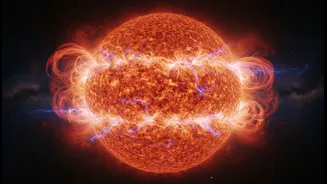
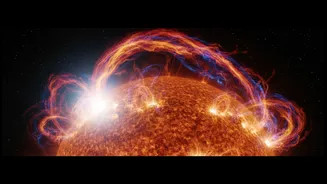
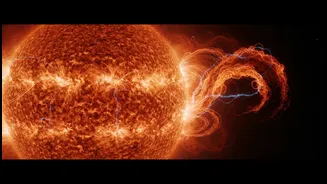
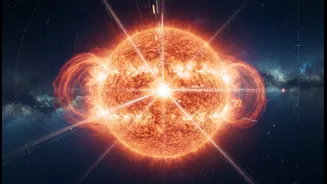
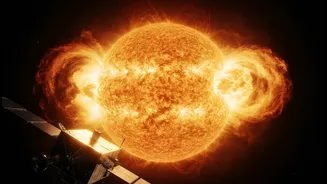
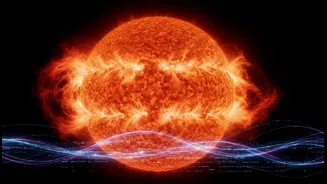
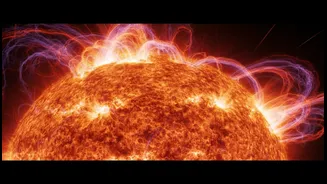
Our star may seem like a constant, steady source of light and heat, but it has a surprisingly turbulent nature. The sun periodically unleashes colossal explosions of plasma and magnetic fields known as coronal mass ejections (CMEs). These are often linked
with solar flares, which are intense bursts of radiation. When a CME is aimed at Earth, it can trigger a geomagnetic storm, a major disturbance of our planet's magnetic field. The frequency of these events varies with the sun's 11-year cycle. Near the peak of a cycle, known as the solar maximum, the sun can produce multiple CMEs per day. We are currently in Solar Cycle 25, which began in December 2019 and has proven to be more active than initially predicted, peaking in late 2024.
A Planet-Sized Blind Spot
For decades, predicting space weather has been a major challenge. Scientists could observe events like CMEs after they happened, but forecasting their trajectory and potential impact on Earth was difficult. This is because we lacked a clear view of the sun's magnetic activity, the engine driving these storms. Our view was largely limited to spacecraft positioned near Earth, giving us little time to prepare. Previous forecasting models provided only about 45 minutes of advance warning for regional effects, which is often not enough for power grid operators and satellite companies to take protective measures. The goal has always been to move from simply observing space weather to accurately predicting it, much like we forecast weather on Earth.
Our New Eyes on the Sun
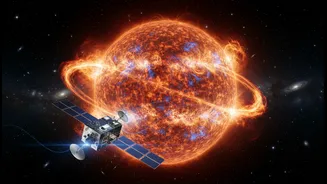
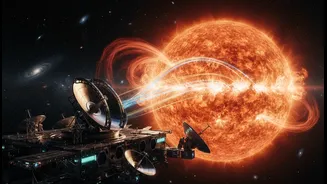
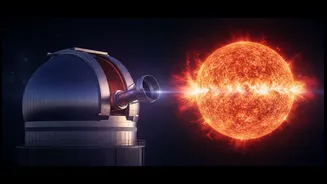
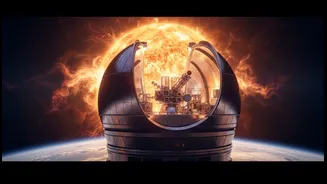
This is where a new wave of powerful observatories comes in. The National Science Foundation's Daniel K. Inouye Solar Telescope in Hawai'i, the most powerful solar telescope in the world, can observe the sun in unprecedented detail. It allows scientists to map the sun's magnetic fields with incredible precision, providing insights into the very source of space weather. Working in concert with space-based missions like the European Space Agency's Solar Orbiter and NASA's Parker Solar Probe, we are getting a multi-dimensional view. The Solar Orbiter, launched in 2020, is providing the first-ever close-up images of the sun's poles, a crucial region for understanding the solar magnetic field. These tools work together, with the Parker Probe flying directly through the sun's outer atmosphere (the corona) to sample particles, while the Solar Orbiter and Inouye Telescope observe from a distance.
Why Better Forecasts Matter
A powerful geomagnetic storm could have devastating consequences for our technology-dependent world. The most famous example, the Carrington Event of 1859, fried telegraph systems across the globe. A similar event today could cripple power grids, potentially causing widespread, long-lasting blackouts. It could also damage or destroy the satellites we rely on for GPS, communication, and weather forecasting, and disrupt radio signals used by aircraft. Recent studies even suggest that the effects of extreme storms could be more severe than previously thought, challenging older assumptions about Earth's natural defenses. By improving our ability to forecast these events, we gain crucial lead time—hours or even days—to protect these vital systems. Power companies can reroute power, satellite operators can put their spacecraft into a safe mode, and airlines can divert flights from polar routes where radiation is higher.