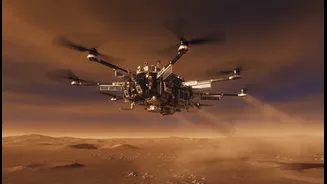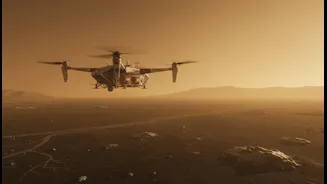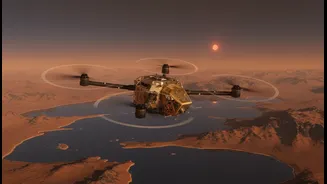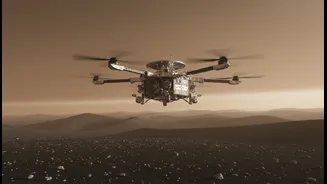









A Drone for an Alien World
Planetary exploration has long been the domain of orbiters, landers, and rovers. While rovers on Mars have provided incredible insights, they are slow, covering tens of kilometers over many years. NASA's Dragonfly mission, set to launch in July 2028,
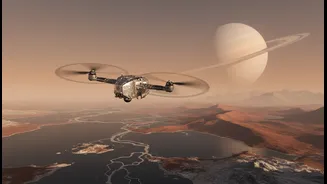
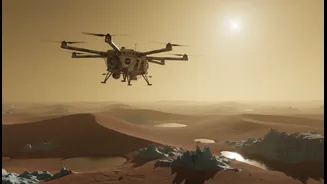
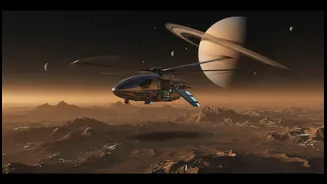
completely rewrites the script. Dragonfly is a nuclear-powered, eight-rotor drone, or rotorcraft, destined for Saturn's largest moon, Titan. After its arrival in 2034, it will become the first vehicle to perform powered, controlled flight on another moon, hopping from one intriguing location to the next. This mobility is the key to its revolutionary potential, allowing it to function as a relocatable lander and conduct science across vast and varied terrains.
Titan: An Earth-Like, Yet Alien, Mystery
So, why Titan? Among all the worlds in our solar system, Titan is exceptionally compelling. It is the only moon with a thick atmosphere—four times denser than Earth's—and a surface where liquid flows in rivers, lakes, and seas. However, with surface temperatures around -179°C, this liquid isn't water; it's methane and ethane. Titan features an Earth-like cycle of clouds, rain, and erosion, but with methane as the primary agent. Beneath its water-ice crust, evidence points to a vast subsurface ocean of liquid water. Most tantalizingly, Titan's nitrogen-rich atmosphere hosts a complex soup of organic molecules, the carbon-based building blocks of life. It's considered an analog for what early Earth might have been like, making it a prime target for astrobiology.
The Mobility Game-Changer
The ability to fly is what truly sets Dragonfly apart. Titan's combination of a dense atmosphere and low gravity (about one-seventh of Earth's) makes powered flight much easier than on Earth or Mars. This allows the rotorcraft to travel distances that would be impossible for a rover. While Mars rovers have painstakingly covered a few dozen kilometers over their entire missions, Dragonfly is expected to fly hundreds of kilometers. It can leap over hazardous terrain like dunes and craters that would stop a rover in its tracks. This mobility means scientists aren't limited to a single landing site. Dragonfly can visit dozens of geologically diverse locations—from organic sand dunes to the floor of an impact crater where liquid water may have once mixed with surface organics—providing a comprehensive picture of the moon's environment.
A Flying Geochemistry Lab
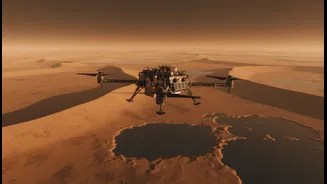
At each new location, Dragonfly will transform into a stationary science platform. Its primary mission is to investigate prebiotic chemistry—the steps that might lead to life. To do this, it carries a sophisticated suite of instruments. The DrACO drill will acquire samples from the surface, which are then fed into the Dragonfly Mass Spectrometer (DraMS) to identify their chemical makeup. This will allow scientists to search for complex organic compounds, including amino acids. Other instruments, like the DraGNS spectrometer, will measure the composition of the ground beneath the lander. It also carries cameras for imaging and meteorological sensors to study Titan's weather. By sampling so many different environments, Dragonfly can build a detailed map of Titan's chemistry and assess its potential habitability.
The Long Journey and Ambitious Goal
The mission's timeline is a testament to its ambition. Following its launch, Dragonfly will cruise through space for six years, arriving at Titan in 2034. Once there, its primary science mission is expected to last over three years. During this time, it will spend most of its life on the ground, recharging its batteries via its Multi-Mission Radioisotope Thermoelectric Generator (MMRTG), the same type of nuclear power source used by the Curiosity rover on Mars. Every 16 Earth days or so, it will take to the skies for another flight, scouting its next landing spot before touching down to begin a new round of analysis. Ultimately, Dragonfly is more than just a flying robot. It's a mission to explore one of the most promising places to search for the ingredients of life, potentially offering clues to how life may have arisen on our own planet.