




A Planet Hunter's Glimpse
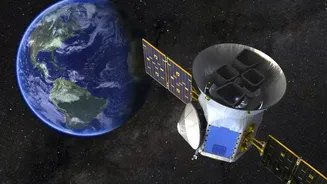
To find worlds beyond our solar system, astronomers often rely on the transit method. NASA's Transiting Exoplanet Survey Satellite (TESS) uses this technique, staring at stars and looking for tiny, regular dips in their brightness. These dips are like
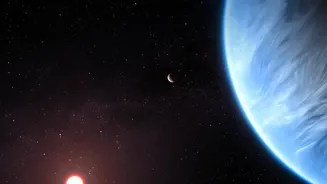
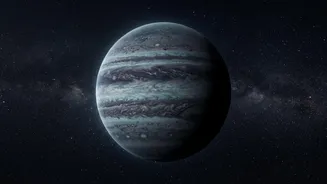
a tell-tale signal that a planet is passing in front of its star from our point of view. Between 2019 and early 2026, TESS routinely observed such transits from the star TOI-2535. The data pointed to a massive planet, a type known as a 'hot Jupiter' because it's a gas giant that orbits extremely close to its star—completing a full year in just over eight Earth days.
An Increasingly Unreliable Target
While the planet was consistently detected for years, its behaviour grew strange. Astronomers noticed its transits were becoming irregular, sometimes arriving up to six hours earlier or later than predicted. Over time, the transits also became shorter and the dip in starlight grew fainter. Then, in March 2026, TESS could no longer detect the transit at all. The characteristic drop in the star's brightness that signalled the planet's passage was gone. From our perspective, the planet had simply disappeared from view. This wasn't a case of equipment failure; something had fundamentally changed in this distant solar system.
The Case of the Hidden Neighbor
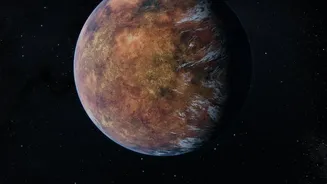
Planets don't just vanish, so scientists knew there had to be a physical explanation. The solution to the mystery lies not with TOI-2535 b itself, but with an unseen companion. Researchers concluded that a second, nearby planet is gravitationally tugging on TOI-2535 b. This constant pulling and pushing between the two worlds has forced both of their orbits into a 'wobble', much like a spinning top. This gravitational dance is so powerful that it's the most extreme example of planetary interaction of its kind ever witnessed.
A Matter of Cosmic Alignment
The transit method only works when a planet's orbit is perfectly aligned with our line of sight to its star. The intense wobble caused by its hidden neighbor has tilted the orbit of TOI-2535 b. Over the seven years of observation, that tilt became so severe that the planet's path no longer crosses the face of its star from our viewpoint here on Earth. It didn't disappear—its orbit simply shifted out of our view. According to Samuel Yee, a UCLA postdoctoral fellow who led the research, the planet's orbit tilted so quickly that its transit vanished while astronomers were actively watching.
What This Tells Us About the Universe
This discovery does more than solve a single cosmic mystery; it provides new insights into how planetary systems form and evolve. The existence of two massive planets so close together, with such tilted orbits, challenges some theories of planet formation. It suggests that even systems that form in a relatively calm, orderly way can be dynamically altered over time. While TOI-2535 b won't be visible again for an estimated 30 to 50 years, astronomers will continue to watch its star. There's a chance its hidden companion may wobble into a transiting position much sooner, giving us our first direct look at the planet responsible for this remarkable vanishing act.