







The Science of Sand Power
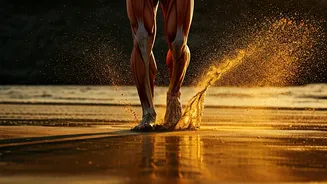
Training on sand is fundamentally different from working out on a hard, stable surface like a gym floor or pavement. The secret lies in instability and resistance. Every time your foot lands, the sand shifts, forcing the small stabiliser muscles in your feet,
ankles, knees, and hips to work overtime to keep you balanced. According to studies in sports science, this increased muscle recruitment leads to greater strength gains and improved joint stability over time. Furthermore, sand acts as a natural shock absorber. When you jump or run, the soft surface dissipates the impact forces, reducing stress on your joints. This makes it an ideal environment for plyometrics—explosive exercises—allowing you to train for power with a lower risk of overuse injuries.
Why You Should Ditch the Shoes
The “barefoot” part of this workout is not just a suggestion; it’s a core component. Your feet are packed with nerve endings that provide crucial feedback to your brain about your body's position in space—a sense known as proprioception. Shoes, especially cushioned ones, dull this feedback. Training barefoot on an uneven surface like sand supercharges your proprioceptive system. This enhances your balance, coordination, and agility. It also strengthens the dozens of small muscles, tendons, and ligaments within your feet, building a stronger, more resilient foundation for all movement. A strong base is essential for generating power that transfers up through your legs and core.
The Essential Warm-Up
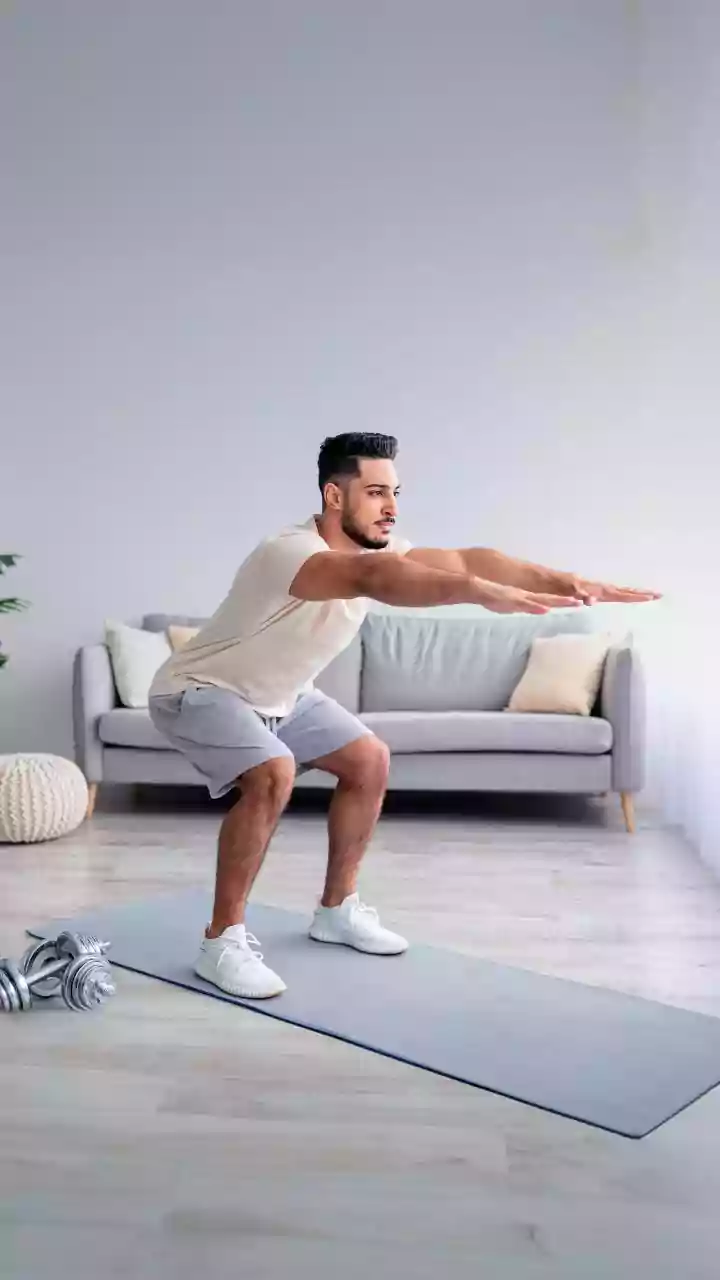
Never jump straight into an intense sand workout. The unstable surface demands that your muscles and joints are properly prepared. Begin with a 5 to 10-minute light jog along the shoreline where the sand is firmer and more compact. This will gradually increase your heart rate and blood flow. After jogging, move into dynamic stretches. Perform 10-15 leg swings (forward-and-back and side-to-side) on each leg, deep bodyweight squats, and torso twists. Finish by doing ankle circles in both directions to prepare them specifically for the demands of the soft sand.
Exercise 1: Explosive Broad Jumps
This exercise is a pure test of horizontal power. Stand with your feet shoulder-width apart. Lower into a half-squat and swing your arms back. From this position, explode forward, driving through your heels and swinging your arms forward for maximum momentum. Aim to jump as far as you can. The key is to land softly, bending your knees to absorb the impact. The sand will make the push-off more difficult and the landing safer. Reset your position after each jump. Aim for 3 sets of 6-8 jumps.
Exercise 2: High-Knee Sprints
Sprinting on sand requires immense power output because there’s no firm ground to push off from. Mark a distance of 20-30 metres on the softer, drier sand. From a standing or athletic start, sprint to the finish line, focusing on driving your knees up as high as possible with each stride. This exaggerated form forces your hip flexors and glutes to work harder. Walk back to the starting point for your recovery, then repeat. Complete 6-8 sprints.
Exercise 3: Power Skips for Height
This plyometric drill develops vertical power and coordination. It’s an exaggerated skip, but with a focus on jumping as high as possible on each step. Start skipping, but with each alternating leg, drive your knee up forcefully and explode off the ground. Use your arms to help propel you upward. The goal is to gain height, not distance. The sand will force you to generate maximum power on every single take-off. Perform for a distance of 20 metres, rest, and repeat for 4 sets.
Exercise 4: Lateral Bound and Stick
Athletic power isn't just linear; you need to be strong moving side-to-side. Stand on your right leg. Bend your knee slightly and leap sideways, as far as you can, landing on your left leg. The challenge is to “stick” the landing—hold your balance for a second on the sand without your other foot touching down. The instability will make this incredibly difficult, firing up your glutes and hip stabilisers. Immediately bound back to the right leg. That’s one rep. Aim for 3 sets of 10-12 total reps.