



An Eclipse Just Beyond Our Horizon
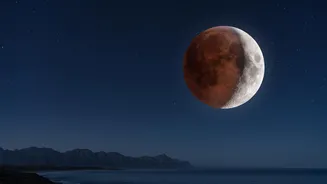
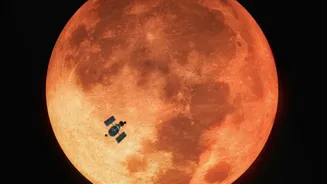
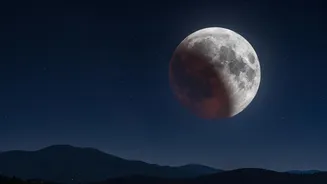
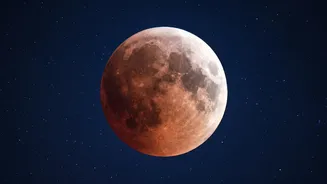
The major celestial event on August 28, 2026, is a deep partial lunar eclipse where over 90% of the Moon will pass through Earth's dark umbral shadow. This will create a dramatic sight, making the Moon appear coppery or reddish for those in the viewing
path. Unfortunately, this impressive event will not be visible from India. The eclipse takes place during daytime hours in the Indian subcontinent, with its maximum phase occurring around 9:43 AM Indian Standard Time (IST). By the time night falls in India, the eclipse will be long over. The prime viewing locations for this particular event are across North and South America, as well as parts of Europe and Africa.
Understanding a Lunar Eclipse
A lunar eclipse is a straightforward celestial alignment. It happens when the Earth positions itself directly between the Sun and the full Moon, casting its own shadow onto the lunar surface. Earth's shadow has two parts: a faint, outer shadow called the penumbra, and a dark, inner shadow called the umbra. When the Moon passes only through the penumbra, it creates a penumbral eclipse, which is often so subtle it's hard to notice. A partial eclipse occurs when a part of the Moon enters the umbra, looking like a dark bite is being taken out of it. A total lunar eclipse, the most dramatic of the three, happens when the entire Moon is engulfed by the Earth's umbra.
The Magic of a 'Blood Moon'
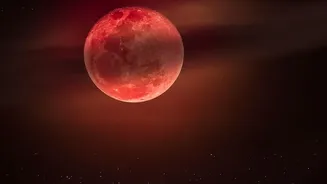
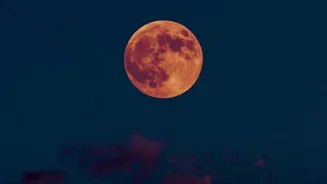
During a total lunar eclipse, the Moon doesn't disappear completely. Instead, it often glows with a faint, reddish hue, earning it the popular nickname "Blood Moon." This eerie and beautiful light is the result of sunlight filtering through Earth's atmosphere. As sunlight passes through our atmosphere, the blue light gets scattered away, while the red light gets bent or refracted toward the Moon. In effect, you are seeing the light of all the sunrises and sunsets on Earth being projected onto the lunar surface. Skywatchers in India had a chance to see this phenomenon earlier in the year, during the total lunar eclipse on March 3, 2026, which was visible during moonrise in many parts of the country.
Tips for the Next Visible Eclipse
When a lunar eclipse is visible from India, being prepared can make all the difference. The most important tip is also the easiest: find a viewing spot with a clear view of the sky, preferably away from bright city lights. Light pollution can wash out the subtle colours and details of the eclipsed Moon. Unlike a solar eclipse, a lunar eclipse is perfectly safe to watch with your naked eyes. You do not need any special filters or protective glasses. In fact, using them would make the already dim Moon impossible to see. To get a more detailed view of the craters and seas as Earth's shadow creeps across them, consider using a pair of binoculars or a small telescope. These instruments are also perfectly safe to use without any special filters.
A Crucial Note on Safety: Lunar vs. Solar
It is essential to distinguish between viewing a lunar eclipse and a solar eclipse. Looking at the Sun directly, even when it is partially covered during a solar eclipse, can cause severe and permanent eye damage. Specialised solar viewing glasses or filters that meet the ISO 12312-2 international safety standard are mandatory for observing a solar eclipse. A lunar eclipse, on the other hand, involves looking at the Moon, which is only reflecting sunlight and is never bright enough to harm your eyes. The Moon is actually dimmer than usual during an eclipse, making it even more comfortable to observe for long periods. So, when the next lunar eclipse comes around, you can relax and enjoy the view without any worry.