





First, What Is Conventional Swing?
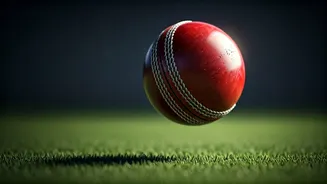
To understand reverse swing, you first need to grasp conventional swing. With a new, hard cricket ball, the fielding team works tirelessly to polish one side, making it smooth and shiny, while the other side naturally scuffs up. Air flows smoothly and quickly
over the shiny side but becomes turbulent and slower over the rough side due to friction. This difference in air pressure creates a force that pushes the ball *towards* the rough side. So, if a bowler holds the seam angled towards the slips with the shiny side on the left (for a right-handed batsman), the ball will swing away—an outswinger. This is the predictable, orthodox movement bowlers rely on in the early overs.
The Ball Ages: Setting the Stage for Reverse
As the game progresses, typically after 30-40 overs, the ball's condition changes dramatically. The 'rough' side becomes heavily abraded and scarred, while the 'shiny' side, despite constant polishing, is no longer pristine. This extreme difference in texture is crucial. The phenomenon is most effective on dry, abrasive pitches, like those often found in the Indian subcontinent, which accelerate the wear and tear on the ball. This creates the perfect asymmetrical object for the laws of aerodynamics to do something extraordinary.
The Physics of the Reversal
This is where it gets interesting. Reverse swing happens when the ball is bowled at high speed, usually above 135-140 km/h (around 85 mph). At this velocity, the roles of the two sides flip. The extremely rough side creates a thick, chaotic 'turbulent boundary layer' of air that separates from the ball's surface very early. Counter-intuitively, the high speed allows the air on the *smoother* (shiny) side to also become a turbulent—but thinner and more energetic—layer. This layer clings to the ball for longer before separating. Because the air stays attached longer on the shiny side, it creates a pressure differential that pushes the ball in the opposite direction of conventional swing—that is, *towards* the shiny side. An intended outswinger now becomes a devastating inswinger.
The Art of Ball Management
Reverse swing isn't an accident; it's a team effort. From the moment the innings begins, one side of the ball is designated to be polished. Fielders, using sweat and tireless rubbing, keep that side as smooth and dry as possible. The other side is left to deteriorate naturally, scuffing up on the abrasive pitch and outfield. This meticulous process, often called 'ball management', is a tactical discipline. It has also been a source of controversy, with accusations of using illegal means—like sugary saliva, lip balm, or even bottle caps—to alter the ball's surface and hasten the conditions for reverse swing.
The Bowler's Supreme Skill
Having the right ball is only half the battle. Executing reverse swing requires immense skill. Firstly, the bowler needs genuine pace, as the effect only kicks in at high speeds. Secondly, it demands incredible control over the wrist and seam position. Masters of the art can deliver the ball with the same seam position and action for both conventional and reverse swing, making it almost impossible for the batsman to predict the direction of movement. The late, sharp deviation is what makes it so lethal, as it gives the batter a fraction of a second to react.
The Masters of the Craft
The story of reverse swing is synonymous with Pakistani fast bowlers. Sarfraz Nawaz is often credited with discovering it in the 1970s, later passing the knowledge to the legendary Imran Khan. But it was the duo of Wasim Akram and Waqar Younis who turned it into a devastating art form in the 1990s. Their ability to make the old ball 'talk' at searing pace changed the dynamics of fast bowling. In the modern era, bowlers like India's Zaheer Khan and Mohammed Shami, South Africa's Dale Steyn, and England's James Anderson have become renowned practitioners, using it as a key weapon in their arsenal.



![[WATCH] Vaibhav Sooryavanshi's first training session with India's senior squad](https://g-mob.glance-cdn.com/public/fc/image/NkbYTmvnldP0.webp)