





From Workhorse to Innovator
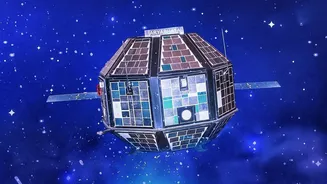
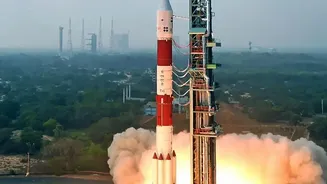
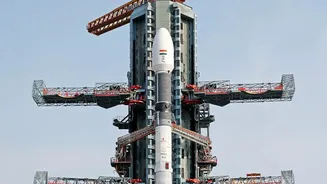
For decades, the Indian Space Research Organisation (ISRO) earned a global reputation as a dependable partner for sending satellites into orbit. But a strategic shift is underway. Buoyed by recent successes and guided by the ambitious Indian Space Policy
2023, the country is transitioning from a state-led operational model to a dynamic ecosystem encouraging private innovation. This new framework allows ISRO to focus on cutting-edge research and development, effectively passing the torch of routine manufacturing and operations to a burgeoning private sector. The goal is no longer just to participate in the space economy but to lead it with next-generation technology. And at the heart of this ambition are two of the most transformative technologies of our time: artificial intelligence and quantum science.
AI: The Onboard Brain for Smarter Satellites
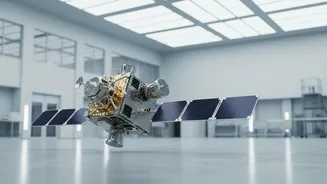
Imagine a satellite that doesn't just passively collect data but actively thinks. That's the promise of integrating AI and machine learning into space systems. Instead of beaming petabytes of raw data back to Earth for analysis, future Indian satellites will process information right in orbit. This onboard edge computing has profound implications. For disaster management, a satellite could autonomously detect a wildfire or flood, analyze its spread, and send actionable alerts to ground crews in near real-time, bypassing hours of delay. For agriculture, it could identify crop diseases or water stress on its own, providing farmers with instant insights. AI will also make satellites more autonomous and resilient. These smart systems can manage their own power, perform self-diagnostics to predict and fix problems, and even navigate to avoid space debris, extending their operational lifespan and reducing the need for constant human intervention.
Quantum: The Unbreakable Shield and Ultrasensitive Eye
If AI provides the brain, quantum technology offers the shield. The most immediate application for India is Quantum Key Distribution (QKD), a revolutionary form of encryption. Unlike conventional methods that rely on mathematical complexity, QKD is based on the laws of physics. Any attempt to intercept the key fundamentally alters it, immediately revealing the presence of an eavesdropper. ISRO has already successfully demonstrated free-space QKD over short distances and is gearing up for satellite-based systems. This will create unconditionally secure communication channels, a vital capability for protecting sensitive military, financial, and government data. Beyond security, quantum sensing promises to equip satellites with unprecedented observational power. These sensors could detect minute gravitational variations to map underground water reserves or mineral deposits with incredible precision, offering a new frontier in resource management.
Policy and Players Driving the Change
This technological push is not happening in a vacuum. The Indian Space Policy 2023 is the key enabler, explicitly designed to institutionalize private sector participation in everything from satellite manufacturing to launch vehicle operation. The creation of IN-SPACe as a single-window agency is meant to streamline authorization and provide a level playing field for startups and established companies alike. This has unleashed a wave of entrepreneurial energy, with over 190 space startups emerging in recent years, some of which, like Bengaluru-based Pixxel, are already using AI to process satellite imagery. ISRO, meanwhile, is actively pursuing futuristic projects under its Directorate of Technology Development and Innovation, including intelligent satellites and a clear roadmap for satellite-based quantum communication. This synergy between public-sector research and private-sector agility is the engine driving India's next chapter in space.
A New Competitor on the Global Stage
By integrating AI and quantum technologies, India isn't just upgrading its capabilities; it's positioning itself to compete directly with space giants like the U.S. and China. This leapfrog strategy focuses on services where the future market lies: intelligent data analysis, autonomous constellation management, and ultra-secure communications. This shift is turning heads globally, with ISRO already collaborating with agencies like NASA on advanced missions. For the United States and other established space powers, India's rise represents both a new competitor and a potential partner in an increasingly complex and crowded space environment. The nation's ability to innovate at a lower cost-point could disrupt the market for high-end satellite services, while its focus on these emerging technologies signals its ambition to become a rule-maker, not just a follower, in the 21st-century space race.