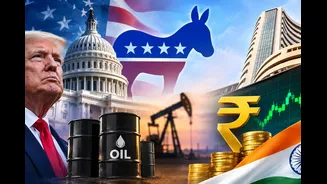





The votes are in, and the 2026 US midterm elections have delivered a decisive victory for the Democratic party, which has gained control of both the House and Senate. For investors in India and beyond, the question is: what now?
A New Balance of Power
The election results mark
a significant shift in the American political landscape. Democrats have secured majorities in both chambers of Congress, flipping dozens of seats in what is being described as a 'blue wave'. This ends unified Republican control in Washington and sets the stage for a period of divided government, as President Donald Trump, a Republican, remains in the White House for the next two years. This new dynamic is critical for markets because it changes the calculus for passing new laws. While Democrats can now set the legislative agenda, they will still need to contend with the president's veto power, making major, sweeping policy changes less likely. This scenario, often called 'gridlock', can sometimes be viewed positively by markets as it reduces policy uncertainty.
Key Policies on the Investor Radar
Investors are now parsing the results for clues on several key policy fronts. The first is fiscal policy. With Democrats in control, planned spending cuts to programmes like Medicaid could be delayed or softened, which could support consumer spending and economic growth. However, the prospect of legislative gridlock makes large new stimulus packages less probable. Another major focus is trade. The Trump administration's use of tariffs has been a source of global market volatility. A Democratic-controlled Congress is expected to bring greater scrutiny to these policies, which could ease some trade tensions for countries like India. However, the president retains significant executive authority on trade, meaning uncertainty will persist.
Sector-Specific Tremors
The election outcome is not uniform in its market impact; certain sectors are more exposed than others. Technology stocks, particularly those linked to Artificial Intelligence (AI), faced immediate pressure. This was driven by concerns that new Democratic leadership at both the federal and state levels could lead to tighter regulation on data centre development. Conversely, the defence sector also saw stocks weaken on expectations of greater scrutiny over spending and foreign policy, including the conflict with Iran. A potential diplomatic breakthrough with Iran could also push oil prices lower, which would benefit energy-importing nations like India by reducing costs for sectors such as aviation, paints, and chemicals. For India's crucial IT services sector, the focus remains on H-1B visa rules and US corporate spending, which will now be subject to a new political lens.
The View From India
For Indian markets, the US election results create a mixed but cautiously optimistic picture. A potential softening of the US dollar and lower US Treasury yields could encourage more Foreign Portfolio Investment (FPI) flows into India. The immediate market reaction in India saw the Nifty 50 gain, although the IT index fell, reflecting sector-specific concerns. Indian officials have expressed relief at the prospect of reduced pressure on trade tariffs, which could provide breathing room in ongoing negotiations for an India-US trade deal. However, they remain cautious, noting that a politically bruised President Trump could lead to new uncertainties in the bilateral relationship. The key factors for India in the months ahead will be the direction of US trade policy, global oil prices, and the flow of foreign capital.