


A Quantum Leap for a Space Lab
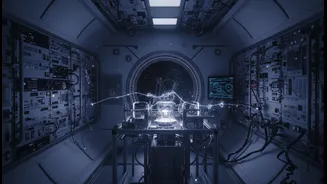
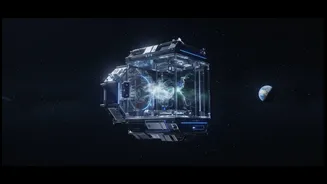
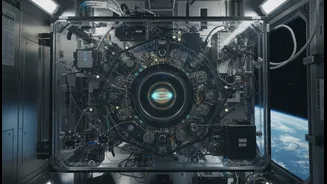
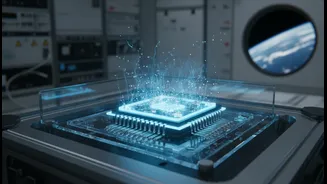
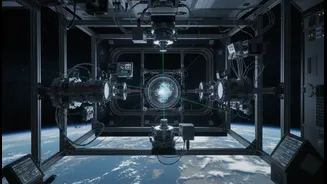
Astronauts aboard the International Space Station have activated a newly upgraded science instrument that promises to unlock deeper mysteries of the universe. The Cold Atom Laboratory (CAL), a facility that has been operating on the ISS since 2018, recently
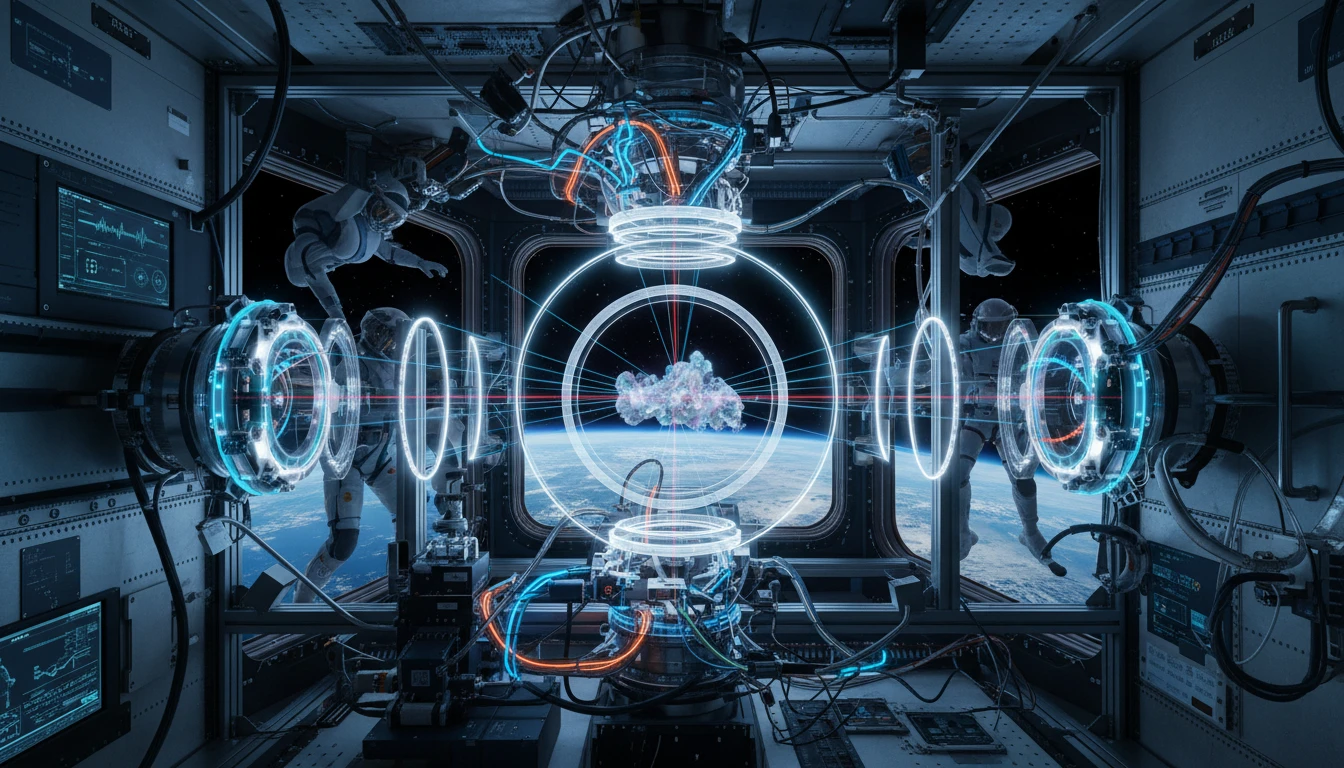
received its fourth major enhancement. The upgrades, launched to the station in April 2026 and installed in May, include significant improvements like a redesigned magnetic trap to confine atom clouds and better atom sources. These new tools give researchers at NASA's Jet Propulsion Laboratory, who control the experiment remotely, more powerful ways to create and manipulate matter at temperatures colder than anything known in nature. The goal is to study the fundamental nature of matter, pushing the boundaries of what we know about quantum physics.
The Science of Absolute Zero
At room temperature, atoms zip around at incredibly high speeds. But when cooled to just a fraction of a degree above absolute zero (minus 273.15 degrees Celsius), they slow to a crawl and begin to behave in very strange ways. In these extreme conditions, certain atoms can enter a fifth state of matter, distinct from solids, liquids, gases, and plasmas, known as a Bose-Einstein Condensate (BEC). In a BEC, individual atoms lose their identity and merge into a single, massive quantum wave. This allows scientists to observe quantum phenomena, which are normally microscopic, on a macroscopic scale. The Cold Atom Lab uses lasers to cool clouds of rubidium and potassium atoms, creating these BECs to study their bizarre and fascinating properties.
Why Zero Gravity Is the Perfect Lab
While scientists can create BECs in labs on Earth, gravity is a major problem. The magnetic traps used to hold the ultracold atoms must be strong enough to fight against gravity's constant pull, which limits how cold the atoms can get and for how long they can be observed. On Earth, these delicate quantum states are often observable for only milliseconds before gravity rips them apart. The microgravity environment of the ISS effectively eliminates this problem. Without gravity's interference, the magnetic traps can be made much weaker, allowing the atom clouds to expand, cool to even lower temperatures, and be observed for much longer periods—sometimes for over a second. This extended observation time is like hitting a cosmic slow-motion button, giving researchers an unprecedented window into the quantum realm.
Unlocking the Universe's Secrets
The ability to study these long-lived, ultra-cold atoms in space opens the door to probing some of the biggest questions in physics. Researchers plan to use the upgraded CAL to perform hyper-precise tests of fundamental principles, such as Einstein's theory of general relativity. By creating BECs from two different types of atoms (like rubidium and potassium) and watching how they behave in free fall, scientists can test the equivalence principle with unparalleled accuracy. Furthermore, these experiments could provide insights into mysterious cosmic phenomena like dark energy and dark matter. The strange, wave-like nature of matter at these temperatures could reveal new aspects of the universe that are completely hidden from us in our everyday, warmer world.
From Deep Space to Daily Life
This fundamental research isn't just for theoretical physicists. The work being done on the Cold Atom Lab is paving the way for a new generation of quantum technologies, a field sometimes called 'Quantum 2.0'. The extreme sensitivity of BECs to their surroundings makes them ideal for creating ultra-precise sensors. Future applications could include atom interferometers for navigation that doesn't rely on GPS, incredibly accurate clocks, and new types of gravity sensors that could be used to monitor Earth's water reserves or prospect for resources on the Moon and other planets. According to Kamal Oudrhiri, CAL's project manager at JPL, the upgrades help maintain leadership in space-based quantum tech and mature future instruments for sensing and navigation.