




Beyond Webb: The Next Frontier
The James Webb Space Telescope (JWST) has been a phenomenal success, peering into the early universe and studying the atmospheres of distant gas giants. However, its primary design was not optimised for the incredibly delicate task of finding small, rocky,
Earth-like planets and analysing their atmospheres for signs of life. Finding a planet like Earth orbiting a star like the Sun is like trying to spot a firefly next to a brilliant searchlight from kilometres away. JWST can analyse atmospheres using a technique called transmission spectroscopy, where it studies starlight filtered through a planet's air. But for the ultimate prize — directly imaging an Earth-twin and searching its atmosphere for biosignatures — we need an even more advanced set of tools. This is where the next wave of observatories comes in.
NASA’s Great Ambition: The Habitable Worlds Observatory
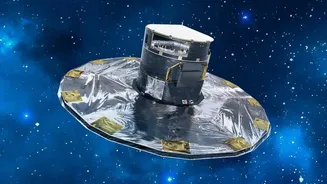
The centerpiece of this new effort is NASA’s planned Habitable Worlds Observatory (HWO). Recommended as the top priority for a large astrophysics mission, HWO is being designed from the ground up for one primary purpose: to find and characterise planets that could support life. Scheduled for a potential launch in the 2040s, this ambitious mission aims to directly image at least 25 potentially habitable worlds. To achieve this, it will employ an advanced coronagraph, a sophisticated internal shield that blocks the overwhelming glare of a parent star, allowing the faint, reflected light of its orbiting planets to be seen. By observing in ultraviolet, optical, and infrared light, HWO will not just see these worlds as dots, but will be able to analyse their light to determine the composition of their atmospheres.
Europe's Planet-Hunting Duo: PLATO and Ariel
While HWO is a long-term goal, European efforts are set to provide crucial data sooner. The European Space Agency (ESA) is preparing two complementary missions. First is PLATO (PLAnetary Transits and Oscillations of stars), scheduled for launch around 2027. Using an array of 26 cameras, PLATO will scan a huge section of the sky, watching up to a million stars for the tell-tale dimming that occurs when a planet transits, or passes in front of it. Its goal is to find and characterise rocky planets, especially those in the habitable 'Goldilocks' zone of Sun-like stars, where conditions might be right for liquid water. Following PLATO, the Ariel (Atmospheric Remote-sensing Infrared Exoplanet Large-survey) mission, launching around 2031, will perform a deep dive on about 1,000 of the planets found by PLATO and others. Ariel is a specialist, designed to do one thing exceptionally well: inspect the chemical makeup and thermal structures of exoplanet atmospheres.
Searching for Life's Fingerprints
These telescopes will not be looking for 'little green men'. Instead, they will be searching for biosignatures — chemical fingerprints in a planet’s atmosphere that hint at the presence of biological processes. On Earth, life has fundamentally changed our atmosphere, filling it with gases like oxygen. Telescopes like HWO and Ariel will use spectroscopy to break down the light from exoplanet atmospheres into their constituent colours, revealing the barcode-like patterns of different molecules. The combined presence of certain gases, such as oxygen and methane, which would normally destroy each other without a constant source, could be a powerful indicator of life. They will also search for water vapour, ozone, and carbon dioxide, painting a complete chemical picture of these distant worlds and allowing scientists to assess their true habitability.