




Why Water Is the Ultimate Prize
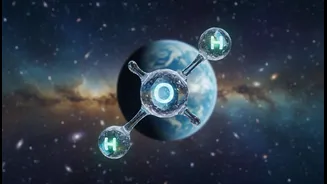
On Earth, life exists almost everywhere there is water. This simple compound, made of two hydrogen atoms and one oxygen atom, is the universal solvent that facilitates the chemical reactions necessary for life as we know it. For this reason, astronomers
have made finding water their top priority when scanning the skies for potentially habitable worlds. The logic is straightforward: if a distant, rocky planet has liquid water, it has one of the key ingredients for hosting life. This 'follow the water' strategy has guided missions and focused the power of our most advanced telescopes on planets that orbit their stars within the so-called "habitable zone"—the specific orbital distance where temperatures are just right for liquid water to exist on a planet's surface.
Reading Rainbows From Light-Years Away
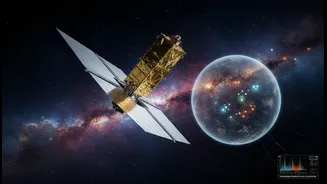
But how do you spot a molecule on a planet you can never visit? Scientists use a brilliant technique called transmission spectroscopy. When an exoplanet passes in front of its host star from our perspective, a tiny fraction of the starlight filters through the planet's atmosphere. Telescopes like the James Webb Space Telescope (JWST) can capture this light and spread it into a spectrum, like a cosmic rainbow. Different molecules in the atmosphere absorb light at very specific wavelengths, leaving behind dark lines in the spectrum. These lines act as a unique chemical fingerprint. By identifying the pattern of absorption lines that match water, astronomers can confirm its presence, even from trillions of kilometres away.
A Landmark Discovery in the Habitable Zone
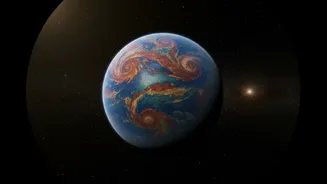
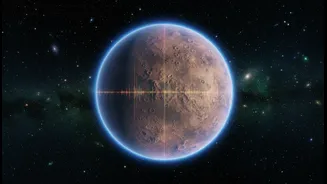
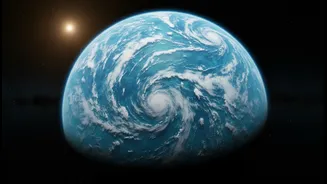
This technique recently led to a breakthrough discovery. In July 2026, scientists confirmed the first-ever atmosphere around a rocky, Earth-like planet squarely within its star's habitable zone. The planet, known as LHS 1140b, is located about 49 light-years away. While larger than Earth, observations strongly suggest it has the right temperature to sustain liquid water and, crucially, an atmosphere to protect it. This is a monumental step forward, moving beyond detections on massive gas giants to a rocky world that presents a tantalizing laboratory for studying habitability outside our solar system. Researchers believe it is now the most promising candidate for astrobiological study.
More Than Meets the Eye
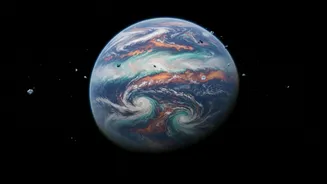
The story of water on other worlds is also growing more complex. Recent studies from mid-2026 suggest that for a common class of planets called sub-Neptunes, the water detected in the upper atmosphere may only be the tip of the iceberg. Sophisticated modelling indicates that under the right conditions, vast quantities of water could sink deeper into the planet, hidden below the lighter hydrogen gas that dominates the observable atmosphere. This means that even the powerful JWST might be underestimating the total water inventory of these worlds. This finding challenges astronomers to interpret their data more carefully and suggests many planets could be far more water-rich than they appear.
A Window into Planetary History
Beyond the search for life, water molecules also serve as fossil records of a planet's past. The presence and amount of water can offer clues about how a planet formed—whether it was born in its current orbit or migrated from a colder region farther from its star. For example, some theories suggest that planets forming close to their star should be dry, receiving their water later from comet and asteroid impacts. However, other research from late 2025 shows that water can be generated through chemical reactions between a hydrogen atmosphere and a molten silicate surface on a young planet. By studying water, scientists are piecing together the chaotic and diverse histories of planetary systems across the galaxy.