

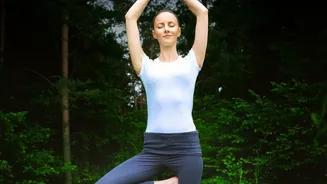

The Foundation of Your Practice
In Sanskrit, 'Tada' means mountain, and 'Asana' means pose. Tadasana, therefore, is about embodying the qualities of a mountain: steady, grounded, and unwavering. While it appears simple, this pose is an active and intentional alignment of the entire
body. It teaches you how to stand with stability and attention, improving postural awareness that translates from your yoga mat into daily life. By understanding the mechanics of Tadasana, you create a solid foundation that enhances balance, strengthens key muscles, and brings a mindful quality to every other pose you practice.
Finding the Ideal Shoulder Position
Modern life, often spent hunched over keyboards and phones, encourages our shoulders to round forward. Mountain Pose directly counters this habit. To find the correct shoulder position, start by standing tall. Inhale and roll your shoulders up toward your ears, then as you exhale, roll them back and allow them to release down your back. The goal is to create width across your collarbones. Your arms can hang naturally by your sides, with palms facing your body or turned forward to encourage this openness. Avoid a rigid, military-like stance; the chest should be open and lifted, but the shoulders should feel relaxed and away from the ears.
Achieving a Neutral Spine
A neutral spine maintains its natural, gentle curves. It's not perfectly flat, nor is it overly arched. In Tadasana, many people make the mistake of either tucking their tailbone under too much, which flattens the lower back, or sticking their hips out, which creates an excessive curve. To find neutral, imagine your pelvis is a bowl of water. You want to keep the bowl level, not spilling water forward or backward. Lengthen your tailbone down toward your heels without aggressively tucking. Simultaneously, gently draw your lower front ribs in and down, as if zipping up a pair of snug pants. This engages your core muscles, which provide essential support for your spine. Your head should be positioned so your ears are aligned over your shoulders, with a slight tuck of the chin to lengthen the back of the neck.
Common Mistakes to Avoid
Perfecting Tadasana is about avoiding common habits. One major error is locking the knees. Always maintain a tiny 'micro-bend' in your knees to keep your leg muscles engaged and protect the joint. Another common issue is uneven weight distribution in the feet. Actively press down through all four corners of both feet: the ball of the big toe, the ball of the little toe, and both sides of the heel. Be mindful not to let your chest collapse or your shoulders creep up toward your ears. The pose is active, but it shouldn't be tense. The idea is to find a balance between effort and ease, standing tall and stable without unnecessary rigidity.
Putting It All Together
Stand with your feet either together or hip-width apart and parallel. Ground down through your feet, feeling the connection to the earth. Engage your thighs by gently lifting your kneecaps, keeping that micro-bend. Find your neutral pelvis, lengthening the tailbone down as you draw your low ribs in. Roll your shoulders up, back, and down, broadening across your chest. Let your arms relax by your sides. Lengthen from your heels all the way up through the crown of your head, as if a string is gently pulling you taller. Hold the pose for 30 seconds to a minute, breathing steadily. Pay attention to the sensations of alignment and stability throughout your entire body.