
A Storm Unlike Any Other
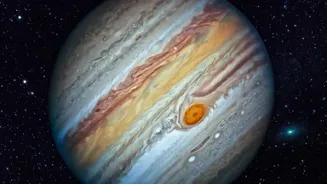
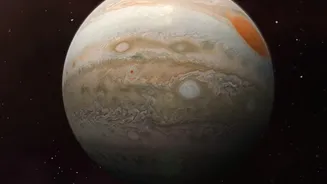
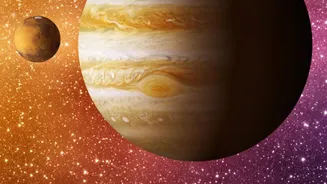
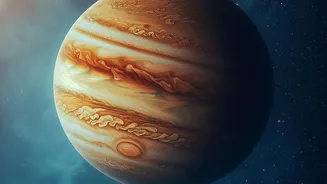
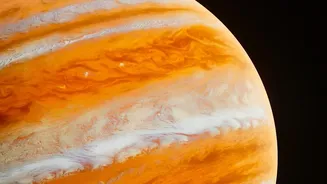
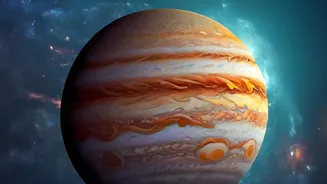
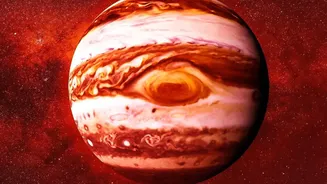
Jupiter’s Great Red Spot is the most legendary storm in the solar system. It is a persistent anticyclone, a high-pressure system that rotates counterclockwise with winds that can exceed 640 kilometres per hour. This vortex is so large that it could easily
swallow Earth. While astronomers have been observing it consistently for more than a century and a half, its origins, its famous crimson colour, and its long-term fate remain profound mysteries. Unlike storms on Earth that weaken over land, this gaseous giant has no solid surface to slow it down, allowing it to rage on for centuries. Its sheer scale and longevity have made it a primary target for planetary scientists trying to understand the extreme weather of gas giants.
New Eyes on a Distant Giant
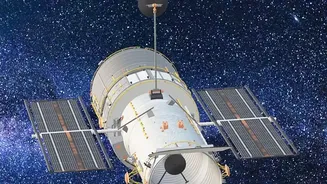
The “new cameras” providing these insights are some of the most powerful telescopes ever built: the Hubble Space Telescope and the James Webb Space Telescope (JWST). Hubble, with its remarkable longevity, has acted as a dedicated 'storm chaser' for Jupiter, providing over a decade of continuous data. This long-term monitoring allows scientists to spot subtle, long-term trends that would otherwise be invisible. More recently, the JWST has used its powerful infrared instruments, NIRSpec and MIRI, to peer into the atmosphere above and within the storm, revealing details about its temperature, cloud structure, and chemical composition in unprecedented detail. Together, these observatories are giving us a multi-layered view of the storm, from its swirling cloud tops to its upper atmospheric layers.
What's Changing Inside the Spot?
Recent observations have uncovered several surprising changes. An analysis of Hubble data from 2009 to 2020 revealed that wind speeds in the storm's outer ring, or 'high-speed lane,' have increased by up to 8 percent. This acceleration, though small year-over-year at less than 2.5 kilometres per hour, is a significant long-term trend. In contrast, winds near the storm’s center are moving much more slowly. Separately, more recent Hubble observations between late 2023 and early 2024 showed the storm itself is behaving strangely, oscillating in shape and size like a “bowl of gelatin.” The entire storm was observed to be squeezing in and out, something never identified before. Furthermore, JWST observations have revealed unexpected and intricate structures in the previously-thought-to-be-boring upper atmosphere above the spot, adding another layer of complexity.
Clues to an Enduring Mystery
So what does all this mean? Scientists are still working to understand the forces driving these changes. The increase in outer wind speeds, combined with the long-observed shrinking of the storm, presents a complex puzzle. Some speculate that the changes in shape, becoming more circular over time, and accelerating winds are signs of the storm's ongoing evolution, though it doesn't necessarily mean its end is near. The 'wobbling' motion has no clear hydrodynamic explanation yet, suggesting that our models of planetary atmospheres may be missing key factors. The discovery of complex structures in the upper atmosphere points to a connection between the storm deep below and the higher layers, possibly driven by powerful atmospheric waves. These findings demonstrate that the Great Red Spot is not a static monolith but a profoundly complex and dynamic weather system, whose every change provides a new clue to understanding the physics of giant planet atmospheres.