


The Ghost of Water Past
Billions of years ago, Mars was a world teeming with water. Evidence gathered by orbiters and rovers paints a vivid picture of a planet with rivers, deep lakes, and possibly even a northern ocean. Features that look uncannily like dry river deltas and lakebeds
are etched into the landscape. NASA's Perseverance rover, exploring Jezero Crater, has provided definitive proof of this past. The crater was chosen as a landing site specifically because orbital imagery showed it once held a lake fed by a river. On the ground, Perseverance found layered sediments consistent with a river delta and rocks whose chemical makeup was altered by long-term exposure to water, confirming that a significant body of water existed there for a prolonged period. Some studies suggest the lake levels in Jezero fluctuated greatly over time before the water disappeared entirely. This ancient water reshaped the Martian surface, leaving behind a geological story that scientists are still piecing together.
A Thin and Restless Sky
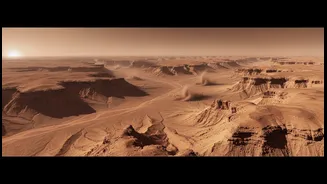
Today's Mars is a starkly different place. Its atmosphere is more than 100 times thinner than Earth's and is composed mainly of carbon dioxide. This thin blanket offers little protection, making it impossible for liquid water to remain stable on the surface for long; it would quickly freeze or evaporate. The temperature can swing wildly, from a relatively mild 20 degrees Celsius to a frigid -153 degrees Celsius. Despite being thin, this atmosphere is incredibly dynamic. It drives planet-encircling dust storms that can last for months, kicking up the iron-rich dust that gives Mars its signature reddish hue. A significant portion of the carbon dioxide atmosphere—up to a third—actually freezes out at the poles during winter, forming seasonal dry ice caps that then sublimate, or turn directly back into gas, in the spring. This process causes massive pressure changes and drives strong winds across the planet.
Where Ice and Air Collide
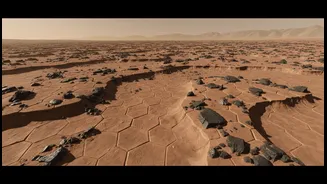
The link between Mars's watery past and its atmospheric present is ice. Vast quantities of water ice are locked away in the polar caps and buried just beneath the surface across the planet. It is here that the surface and atmosphere actively interact through sublimation. As temperatures change seasonally, this subsurface water ice doesn't melt into a liquid but turns directly into water vapor, which enters the thin atmosphere. This process is powerful enough to carve the landscape. Over time, the sublimation of ground ice can cause the ground to collapse, creating pits, scalloped terrain, and complex patterns that scientists have nicknamed "brain terrain". This activity is most common at mid-to-high latitudes, where ground ice is most abundant. The constant exchange of water from solid to gas shows that the planet's water cycle, while unlike Earth's, is still active.
The Evolving Mystery of Dark Streaks
For years, one of the most tantalizing signs of modern water on Mars was features called Recurring Slope Lineae (RSL). These dark streaks appear on steep, warm slopes during summer, fade in the winter, and reappear the next year. Initially, many scientists believed they were caused by seeping briny water. However, the scientific consensus has shifted. More recent research suggests that RSL are more likely dry, granular flows—essentially tiny landslides of sand and dust. While a small amount of water might play a role in starting these flows, perhaps by hydrating salts in the soil, large volumes of liquid water are not believed to be the primary cause. This evolving understanding of RSL demonstrates how scientific interpretation changes with new data, and highlights that even features that look like they're caused by flowing water can be linked to dry atmospheric and surface processes.
Rovers as Geologists and Weather Stations
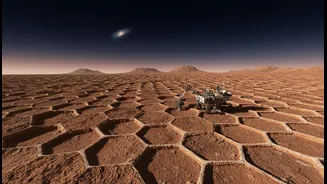
Connecting the dots between ancient geology and modern atmospheric dynamics requires on-the-ground investigation. Rovers like Curiosity and Perseverance act as robotic field geologists and mobile weather stations. They don't just look at the shapes of rocks; they analyze their chemical composition to find traces of past water interactions, such as the organic-bearing mudstones found in Jezero Crater. At the same time, their instruments measure temperature, wind, and atmospheric pressure, providing real-time data on the current Martian climate. NASA's Perseverance rover even used ground-penetrating radar to map buried sediment layers, revealing an even older river delta hidden beneath the one visible on the surface. These missions provide the crucial ground truth that allows scientists to build accurate models of how Mars lost its thick atmosphere and abundant water, and how the remnants of that water continue to shape the planet today.