


The 'Just Right' Location
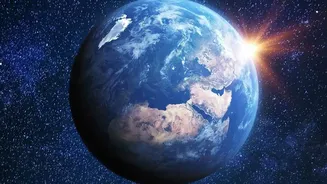
The first and most widely known requirement for a life-bearing planet is its address. Astronomers call this the 'habitable zone,' or more popularly, the 'Goldilocks Zone.' This is the orbital region around a star where conditions are not too hot and not too cold,
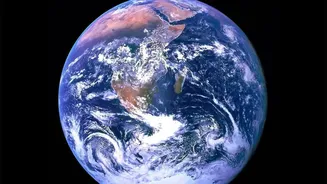
but 'just right' for liquid water to exist on a planet's surface. Too close, and a planet's oceans would boil away, like on Venus. Too far, and they would freeze solid, like on Mars. Our planet orbits comfortably within the Sun's habitable zone, a placement that allows for the vast liquid oceans that cover over 70% of its surface. This zone is the first filter astronomers use when sifting through the thousands of exoplanets discovered, narrowing the search to worlds that have at least a chance of being habitable.
The Essential Ingredient: Liquid Water
Being in the right location is just the start. The presence of liquid water itself is paramount. Life on Earth began in water, and it's considered a necessary ingredient for life as we know it. Water is often called the 'universal solvent' because it can dissolve more substances than almost any other liquid, allowing the complex chemical reactions necessary for life to occur. This property enables it to transport vital nutrients within cells. The unique way water's molecules stick together and its chemical stability make it an ideal medium for life to emerge and thrive. This is why the primary strategy for space agencies like NASA in the search for extraterrestrial life is to 'follow the water.'
A Planetary Bodyguard
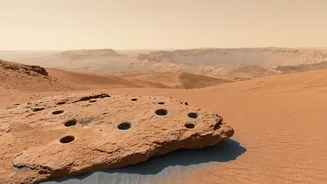
A planet can have liquid water, but it won't keep it for long without a crucial defense system: a magnetic field. Earth's molten iron core generates a powerful magnetic shield that extends far into space. This field deflects the solar wind—a constant stream of charged particles from the Sun that would otherwise strip away our atmosphere over time. Scientists believe this is what happened to Mars, which once had a thicker atmosphere and possibly liquid water but lost them after its magnetic field weakened. Earth's magnetic field acts as a planetary bodyguard, preserving our atmosphere and, by extension, our water and life. When assessing exoplanets, the likely presence of a strong magnetic field is now considered a vital sign of long-term habitability.
A Planet in Motion
A less obvious but equally critical feature of Earth is its dynamic geology. Our planet's crust is broken into massive plates that are in constant, slow motion—a process known as plate tectonics. This geological activity is unique to Earth in our solar system. Plate tectonics plays a crucial role as a planetary thermostat. It helps regulate the amount of carbon dioxide in the atmosphere, preventing a runaway greenhouse effect and keeping the climate relatively stable over geological timescales. This process also recycles essential nutrients and drives the formation of continents and mountains, which in turn create diverse ecosystems for life to adapt to. While some research suggests life may have first emerged without it, plate tectonics is seen as key to sustaining a habitable environment over billions of years.
The Perfect Atmospheric Blanket
Finally, Earth's atmosphere does more than just provide air to breathe; it's a multi-layered life-support system. It keeps the planet warm through a moderate greenhouse effect, preventing the wild temperature swings seen on planets without a substantial atmosphere. It contains the right mix of gases, including oxygen for animals and carbon dioxide for plants. Critically, a layer of ozone in the upper atmosphere absorbs most of the Sun's harmful ultraviolet (UV) radiation, protecting life on the surface from damage. This atmospheric blanket works in concert with the magnetic field and plate tectonics to create a stable, protected environment where life could not only arise but evolve into the complex forms we see today.