

It's a Brand-New Discovery
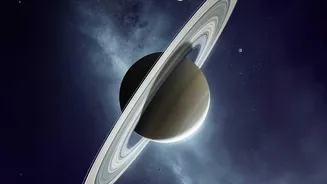
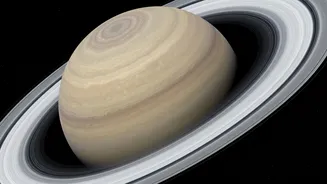
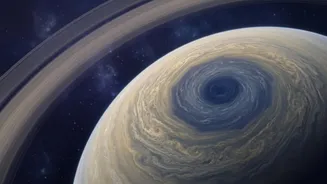
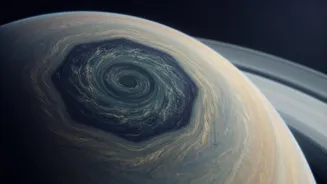
For over 40 years, astronomers have been captivated by a giant, stable hexagon swirling around Saturn’s north pole. It was long considered a one-of-a-kind wonder in our solar system. Scientists had searched for a southern counterpart for decades without
success. That all changed in early September 2026, when an international team of scientists announced the discovery of a massive, 10-sided atmospheric wave wrapped around the planet’s south pole. The finding, published in the journal Science Advances, was made using recent images from the Hubble Space Telescope. This confirmed what ground-based observers, including amateur astronomers, had started to notice in 2024: something strange and geometric was brewing in the southern hemisphere. The discovery proves that Saturn’s northern hexagon isn't a complete anomaly, opening up a new chapter in understanding the atmospheres of giant planets.
It Wasn't There Before
Perhaps the strangest thing about the decagon is that it’s a recent arrival. This isn’t a feature that was simply overlooked; we have proof that it didn't exist just a few years ago. NASA’s Cassini spacecraft orbited Saturn for 13 years, from 2004 to 2017, and extensively mapped the south pole. It saw a powerful hurricane-like vortex at the pole but found no evidence of a persistent, geometric shape like the northern hexagon. The Cassini mission saw only circular jet streams. This makes the new discovery incredibly exciting for scientists. Data from Hubble shows that subtle hints of the structure began appearing in 2023, becoming a more defined 10-sided pattern through 2024 and 2025. Astronomers are getting a rare opportunity to watch a giant planetary feature form and evolve in almost real-time.
It Has Ten Sides, Not Six
While having a polar polygon is no longer unique to Saturn's north pole, the new southern feature is distinctly different. It is a decagon, a 10-sided shape, not a hexagon. This immediately raises questions about why the planet would produce two different geometric storms at its poles. The northern hexagon is an incredibly stable structure, rotating with the planet for the more than four decades we’ve been watching it. The decagon, by contrast, appears to be a much more dynamic and evolving system. The discovery was made possible thanks to Saturn’s long seasons. The planet’s axial tilt had hidden the south pole from Earth-based view since 2012. As the pole tilted back into view starting in 2023, astronomers were greeted with this entirely new and unexpected 10-sided storm.
It’s an Evolving Wave, Not a Fixed Fort
Unlike the famously rigid northern hexagon, the southern decagon appears to be a work in progress. Scientists describe it as an evolving atmospheric wave, not a fixed structure. While the hexagon’s corners remain locked in place as it rotates, the vertices of the decagon seem to shift and wobble over time. The feature also appears to be strengthening, with its 10 corners becoming more defined between 2023 and 2025. This suggests it is an active, developing weather pattern. Researchers have noted that it isn't just a surface-level cloud pattern, either. The wave extends vertically through multiple layers of Saturn's atmosphere, indicating it is a deep and powerful phenomenon. This dynamic behavior is something never observed in the northern hexagon, giving scientists a new kind of planetary storm to study.
Its Cause Is a Complete Mystery
Why did a 10-sided storm suddenly form at Saturn’s south pole? The short answer is that nobody knows for sure, which is what makes it so scientifically valuable. Planetary jet streams, like those on Earth, tend to be wavy, but they don't typically lock into stable, geometric shapes. Scientists have theorized that the northern hexagon is a jet stream that has been contorted into a polygon by other atmospheric forces. For the new decagon, one leading hypothesis is that its formation may be linked to a smaller, powerful anticyclone—a high-pressure vortex—spotted churning just north of the feature. This storm may be sculpting the jet stream into its 10-sided shape. However, a similar vortex near the hexagon disappeared long ago while the hexagon itself remained, so the connection is not yet proven.