








The Imaginary Bedrock of Reality
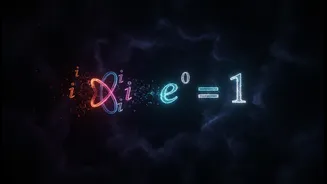
Quantum mechanics is the rulebook for the universe at its smallest scales, describing the bizarre behaviour of atoms and particles. Since its inception in the 1920s, its equations have been built using complex numbers. A complex number is a combination
of a regular 'real' number and an 'imaginary' one—a multiple of the square root of -1, often represented by the symbol 'i'. This was always a bit strange, as things we measure in the real world, like position or energy, are always real numbers. Even one of its founders, Erwin Schrödinger, was unsettled by the use of complex numbers, hoping for a theory based purely on real ones. Despite this, complex numbers seemed indispensable, not just a mathematical convenience. Until now, they were considered a fundamental part of describing everything from how a particle moves to the strange phenomenon of entanglement.
A Challenge to Long-Held Assumptions
The debate over whether complex numbers were truly necessary has simmered for decades. In 2021, a landmark paper seemed to settle it, arguing that any version of quantum theory built with only real numbers would fail to predict the results of certain experiments. Follow-up experiments confirmed that standard, complex-number quantum mechanics made the correct predictions, seemingly cementing the role of 'i' in reality. However, a new study published in Physical Review Letters by a team of physicists from Germany has found a clever way around this conclusion. They realized the 2021 result was based on a specific, standard assumption about how to mathematically combine different quantum systems. By questioning that single rule, they opened the door to a new possibility.
A New Rulebook Without 'i'
The previous roadblock for real-number quantum theory was a rule called the tensor product, a standard method for combining the descriptions of two or more particles. Past attempts using this rule couldn't replicate the results seen in experiments. The team, including doctoral student Pedro Barrios Hita and Professor Dagmar Bruß, developed a new approach. Instead of using the tensor product, they built their model around a different physical principle: that an action on one part of a system shouldn't affect a separate part. By doing this, they successfully created a model of quantum mechanics using only real numbers that makes all the same predictions as the conventional theory. As Professor Bruß explained, this means that for any conceivable experiment, both the real-number and complex-number frameworks will give identical results.
What Does This Mean for Physics?
This breakthrough settles a long-standing philosophical debate: complex numbers are a useful, and perhaps simpler, tool for quantum mechanics, but they are not fundamentally necessary to describe reality. It doesn't change any experimental predictions or immediately point to new technologies. However, it provides a new and deeper perspective on the mathematical foundations of our most fundamental theory of nature. The new formulation shows that the strange features of the quantum world, like entanglement, aren't tied to the strangeness of imaginary numbers. While some researchers note that the new real-number model essentially has to build in structures to mimic the behaviour of complex numbers, the fact that it can be done at all is a major shift in understanding. The next step will be to extend this model to more complicated systems and continue to probe the mathematical heart of the quantum world.