





The Billion-Dollar Junkyard Above
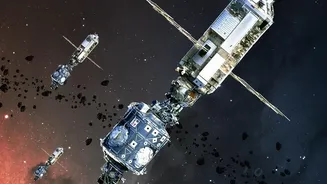
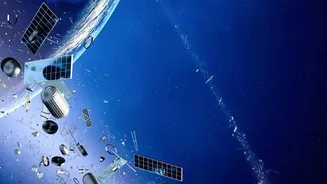
Low Earth Orbit (LEO) is an increasingly hazardous place. For decades, every rocket launch and satellite deployment has left something behind. Today, more than 36,000 objects larger than 10 centimetres are being tracked, from defunct satellites to spent
rocket stages. Add to that an estimated 1.2 million fragments larger than a centimetre, and the total mass of debris exceeds 13,000 tonnes. These aren't just floating passively; they are travelling at speeds up to 28,000 km/h. At that velocity, even a paint chip can cause catastrophic damage to a functional satellite, potentially creating thousands more pieces of debris in a chain reaction known as the Kessler Syndrome. This orbital garbage threatens over a trillion dollars in satellite infrastructure that provides everything from GPS and banking to weather forecasting and internet connectivity.
The Old Way of Dodging Bullets
Until now, avoiding a cosmic collision has been a manual, nerve-wracking process. Ground stations constantly monitor debris and calculate potential collision paths for active satellites. When a high-risk threat is identified—a process that can generate numerous false alerts—satellite operators must make a critical decision. They command the satellite to fire its onboard thrusters to perform an avoidance manoeuvre, nudging it into a slightly different orbit. This process is slow, requires constant human oversight, and consumes precious fuel. Every manoeuvre shortens a satellite's operational lifespan, costing millions in lost revenue and capability. With the explosion of mega-constellations, some operators are already performing hundreds of thousands of avoidance manoeuvres per year, a number expected to grow exponentially.
Enter the Autonomous AI Pilot
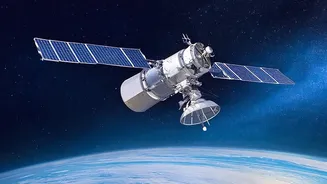
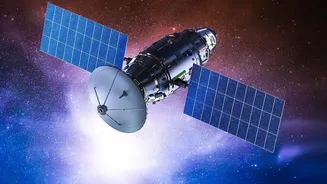
The future of collision avoidance is autonomous. Instead of waiting for commands from Earth, satellites are being developed with the intelligence to protect themselves. This involves two key components: advanced AI software for situational awareness and highly efficient electric thrusters to act on that intelligence. Indian startups and ISRO are actively developing these capabilities. Companies like Digantara are building AI-powered Space Situational Awareness (SSA) platforms that can monitor the orbital environment, detect threats, and predict dangers in real time. This AI acts as an onboard 'pilot', making the split-second decisions needed to keep the satellite safe. This is a crucial step towards ensuring the sustainability of space operations as orbits become more congested.
How AI and Electric Thrusters Work Together
Think of it like a self-driving car navigating traffic. Digantara's AI system, MOSAIC, uses sensors to continuously scan the sky, identifying and tracking objects without human intervention. Its algorithms learn normal satellite behaviour to quickly spot anomalies and calculate collision probabilities. When the AI determines a manoeuvre is necessary, it communicates with the satellite's propulsion system. This is where advanced thrusters, like the Hall-effect thrusters developed by Bengaluru-based Bellatrix Aerospace, come in. These electric propulsion systems use electricity to ionize and accelerate gas, providing a gentle but highly efficient push. They are ideal for the small, precise adjustments needed for collision avoidance and can operate for years, significantly extending a satellite's life compared to traditional chemical rockets.
Why This Matters for India
For India, a rising space power with ambitious plans for its Bharatiya Antariksh Station and a growing fleet of Earth-observation and communication satellites, this technology is a strategic necessity. Protecting these high-value national assets is paramount. ISRO is increasingly incorporating AI into its missions for everything from autonomous operations to spacecraft health monitoring. By fostering a domestic ecosystem of startups like Digantara for SSA and Bellatrix Aerospace for advanced propulsion, India is building sovereign capability in a critical domain. This not only safeguards its own satellites but also positions India as a key player in the global effort to manage space traffic and ensure the long-term sustainability of the space economy. Developing these autonomous systems reduces dependence on foreign tracking data and enhances national space security.