




Hubble's Wide-Eyed Cousin
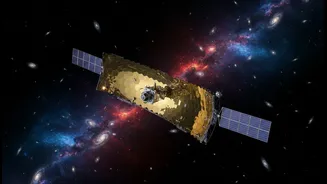
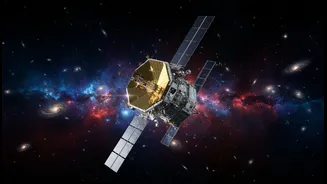
Think of the Roman Telescope as Hubble's incredibly efficient cousin. It has the same size primary mirror—2.4 meters across—but its vision is vastly wider. The Wide Field Instrument on Roman can capture an area of the sky at least 100 times larger than
Hubble can in a single snapshot, all with similar sharpness and clarity. This means that where Hubble provides a keyhole view of the cosmos, Roman will deliver a panoramic vista, allowing it to map the sky up to 1,000 times faster. This incredible survey speed is the key to tackling some of the biggest questions in astronomy, from the nature of dark energy to the census of planets in our galaxy.
Hunting the Universe's Invisible Matter
One of Roman’s primary jobs is to hunt for things we can't see: dark matter and dark energy. Dark matter makes up about 27% of the universe, but we can only detect it by its gravitational effects on the things we can see. Roman will create vast maps of how galaxies are distributed and how their light has been bent by the gravity of intervening matter. This technique, known as weak gravitational lensing, will allow astronomers to chart the location and structure of dark matter more precisely than ever before. At the same time, by studying distant exploding stars called supernovae, Roman will measure the expansion of the universe over time, helping to solve the mystery of dark energy, the force that seems to be pushing everything apart at an accelerating rate.
A New Way to Find Alien Worlds
While telescopes like Kepler and TESS have found thousands of exoplanets by watching for the dip in starlight as a planet transits its star, Roman will add a powerful new technique to the planet-hunting toolkit: gravitational microlensing. This method takes advantage of a phenomenon where a foreground star's gravity acts like a lens, magnifying the light from a more distant background star. If the foreground star has a planet, its own gravity adds a little extra spike to the magnification. This technique is sensitive enough to find planets much farther away and those with wider orbits, including worlds similar to our own solar system's planets and even free-floating 'rogue' planets not bound to any star. Projections suggest Roman could find thousands of planets this way, and up to 100,000 more using the traditional transit method.
The Ultimate Cosmic Surveys
At the heart of Roman's mission are its Core Community Surveys, which will map huge portions of the sky. The High Latitude Wide Area Survey will image and collect spectroscopic data from hundreds of millions of galaxies, creating a 3D map of the universe's structure. This will provide key data for both dark matter and dark energy studies. Another key survey, the Galactic Bulge Time Domain Survey, will repeatedly monitor the dense starfields at the center of our Milky Way. This is the survey that will use microlensing to conduct a census of exoplanets, giving us a much clearer picture of how common planets are across the galaxy.
Practical Choices: How to Follow Along
One of the most exciting aspects of the Roman mission is its commitment to open science. All data collected by the telescope will be non-proprietary and made available to the public through the Mikulski Archive for Space Telescopes (MAST). For those who want to get more deeply involved, NASA and the Space Telescope Science Institute (STScI) are running programs like 'Ready, Set, Roman!' to help prepare the community for the data flood. You can follow mission updates on NASA's official Roman blog, join community forums to discuss the science, and even participate in public engagement events planned around the country for the launch.