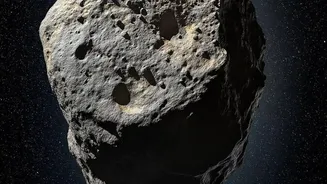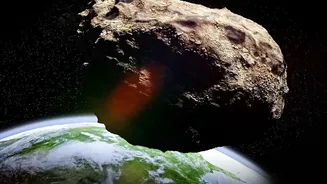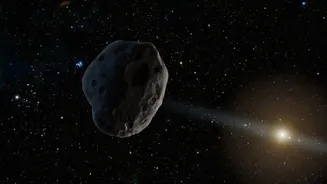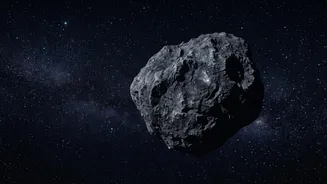




Earth has a temporary new companion, a tiny asteroid named 2026 QQ8 that was captured by our planet's gravity. But this 'mini-moon' won't be around for long, as it prepares to leave its orbit and continue its journey through space.
What Exactly is 2026 QQ8?
Discovered in August
2026 by Hungarian astronomer Krisztián Sárneczky, 2026 QQ8 is a small asteroid, estimated to be only about two metres (or six feet) in diameter. After initial observations, scientists debated whether it was a natural object or a piece of human-made space debris left over from a past mission. However, further studies confirmed it is a naturally formed space rock. In April 2026, the asteroid drifted close enough to our planet for its trajectory to be influenced by the combined gravitational pull of the Earth and the Moon, pulling it into a temporary orbit. This phenomenon has earned it the nickname 'mini-moon'. Despite its new status, it poses no threat. At its closest, it was about 1.5 times farther away than our own Moon, and its tiny size means it would simply burn up in the atmosphere if it ever headed our way.
Our Second Moon? Not Quite
While it’s exciting to think of Earth having a second moon, the term 'mini-moon' can be slightly misleading. Scientists often refer to these objects as quasi-satellites or temporary satellites. Unlike our permanent Moon, which is gravitationally locked to Earth and has been for billions of years, 2026 QQ8 is more of a cosmic guest. It orbits the Sun on a path that is very similar to Earth's, taking about 359 days to complete a loop. Because its orbit is so similar to ours, it periodically gets close to Earth. This time, it passed into a region of space called the Hill sphere, where Earth's gravity dominates over the Sun's, allowing for its temporary capture. So, while from our perspective it seems to be circling us, it's actually in a complex three-body dance with the Earth and Sun.
A Short and Wobbly Journey
The orbit of 2026 QQ8 is not the neat, circular path we associate with our Moon. Instead, it follows a strange, looping trajectory as it gets tugged by different gravitational forces. This delicate balance is why its stay is so short. According to astronomical models, it will complete about one and a half orbits of our planet before being flung back out into its own orbit around the Sun. The asteroid is expected to escape Earth’s gravitational grasp sometime between December 2026 and January 2027. This departure marks the end of its tenure as a mini-moon, at least for now. Its orbital path brings it close to Earth roughly every 10 years, but a capture like this is a much rarer event. Calculations show it will make close passes again in the future, like in 2058, but not close enough to be captured again.
Are There Other Mini-Moons?
The discovery of 2026 QQ8 might seem like a once-in-a-lifetime event, but these temporary captures are more common than you might think. Scientists estimate that at any given time, there is likely at least one mini-moon orbiting Earth. However, their small size and faintness make them incredibly difficult to detect. Previous examples include 2006 RH120, which orbited Earth for about a year, and 2020 CD3, which stayed for nearly three years. Another famous quasi-satellite is Kamoʻoalewa, which is a much more stable companion and may be a fragment of our own Moon. As telescope technology improves, especially with upcoming facilities like the Vera Rubin Observatory, astronomers expect to find many more of these hidden companions, giving us a clearer picture of our dynamic and ever-changing cosmic neighbourhood.