
Seeing the Universe in a New Light
Much of the universe is hidden from the human eye. The visible light we see is only a tiny fraction of the total electromagnetic spectrum. Infrared light, a wavelength longer than visible red light, is invisible to us but carries crucial information.
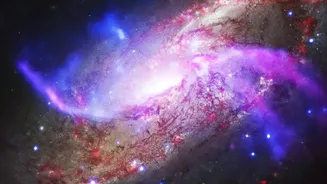
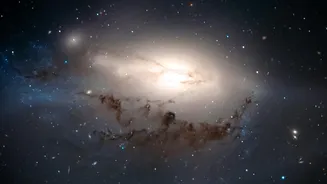
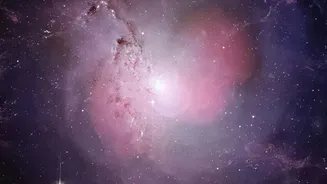
Many celestial objects, like planets, cool stars, and the obscured cores of galaxies, are too faint or cool to shine brightly in visible light but glow in the infrared. Furthermore, vast clouds of cosmic dust, which block visible light, are transparent to infrared waves. This means that by detecting infrared, astronomers can peer inside stellar nurseries where stars and planets are being born and see the glowing dust of ancient galaxies.
Webb's Specialized Infrared Toolkit
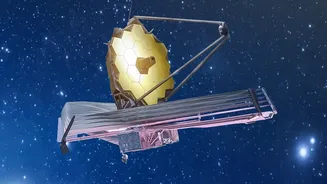
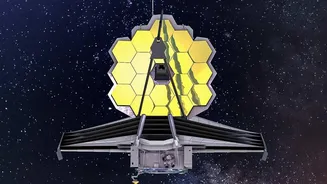
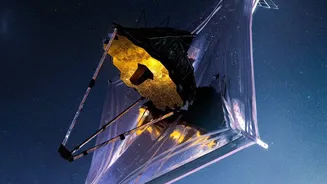
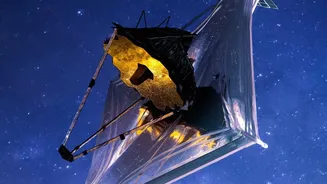
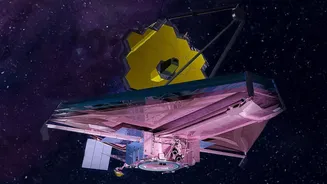
The JWST is engineered specifically to be the most powerful infrared observatory ever built. Unlike the Hubble Space Telescope, which primarily observes in visible and ultraviolet light, Webb focuses on the near- and mid-infrared spectrum. It is equipped with highly sensitive instruments like the Near-Infrared Camera (NIRCam) and the Mid-Infrared Instrument (MIRI). These tools allow Webb to detect objects up to 100 times fainter than what Hubble can see. To achieve this incredible sensitivity, the telescope operates at extremely cold temperatures, shielded from the Sun's heat by a five-layer sunshield the size of a tennis court, because any heat from the telescope itself would blind its own instruments.
A Cosmic Time Machine
One of Webb's most profound capabilities is its ability to look back in time. This isn't science fiction; it's a fundamental property of light. Because light travels at a finite speed, it takes time to cross the vast distances of space. The light from our Moon is 1.3 seconds old when it reaches us, while light from the nearest star beyond our sun is four years old. When Webb observes a galaxy that is billions of light-years away, it is seeing the light that left that galaxy billions of years ago. This allows astronomers to see what the universe was like in its infancy.
Uncovering the Dawn of Galaxies
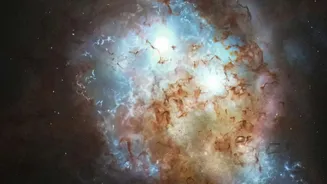
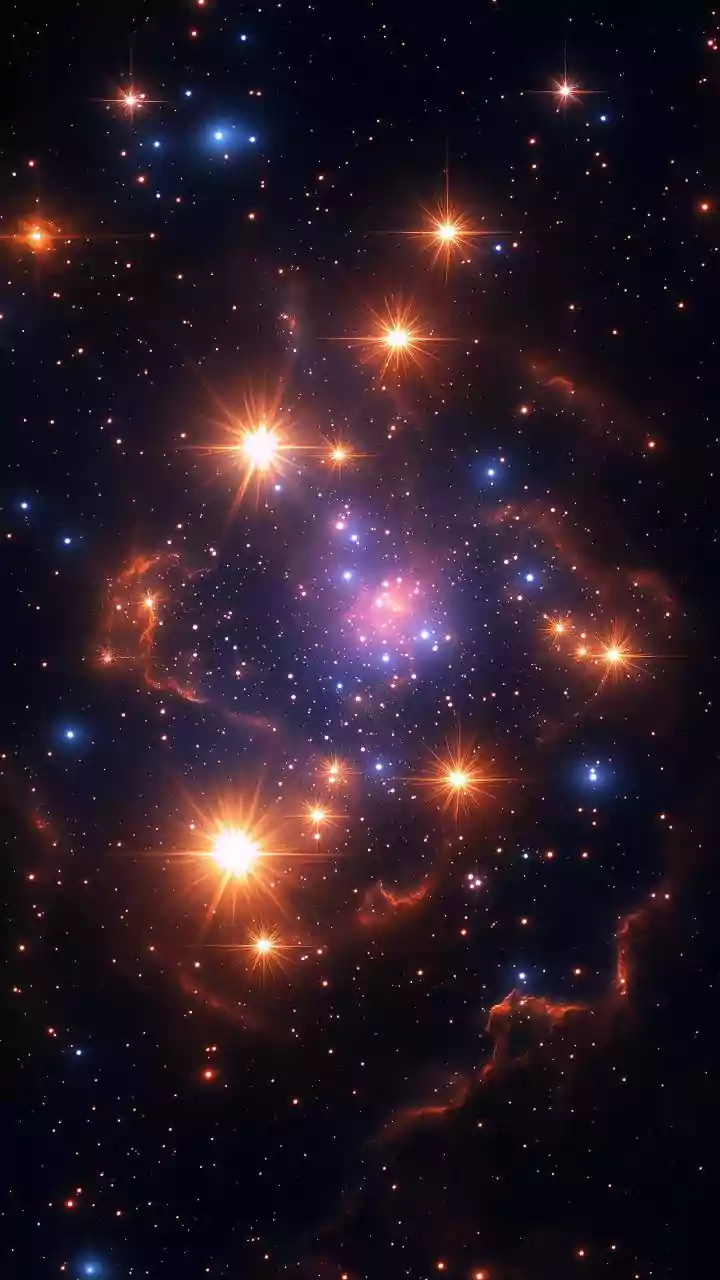
A primary mission for Webb is to study the very first stars and galaxies that formed after the Big Bang. As the universe expands, the light from these distant, ancient objects gets stretched out on its journey to us, a phenomenon called cosmological redshift. Visible and ultraviolet light emitted by the first stars is stretched into the infrared spectrum by the time it reaches Webb. Thanks to its infrared vision, Webb has already discovered hundreds of galaxies that existed when the universe was less than a billion years old. These observations are helping scientists understand how the first galaxies grew, merged, and eventually reionized the universe, clearing the cosmic fog and allowing light to travel freely across space.
From Stellar Birth to Alien Atmospheres
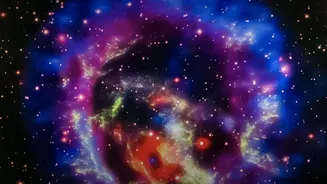
Webb’s infrared eyes are not only for looking at the distant past but also for tracing the life cycle of stars and planets. By peering through dust clouds, it provides unprecedented views of protostars and the swirling disks of material where planetary systems form. This helps unravel the story of how stars like our own sun and planets like Earth came to be. In another exciting application, Webb can analyze the light from a star as it passes through the atmosphere of an orbiting exoplanet. The telescope's instruments can detect the chemical signatures of molecules like water and methane, providing clues about the composition of alien worlds and their potential for hosting life.