




A Day Longer Than A Year
The statement sounds like a riddle, but it's a fundamental truth of Venusian astronomy. Here on Earth, our day (one full rotation on our axis) is about 24 hours, and our year (one full orbit around the Sun) is about 365 days. On Venus, these concepts
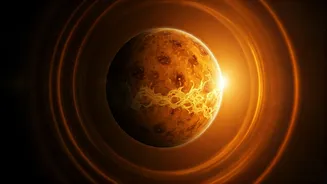
are turned completely upside down. A Venusian year, the time it takes to complete one orbit around the Sun, is roughly 225 Earth days. But a single Venusian day, the time it takes for the planet to rotate once on its axis, is a staggering 243 Earth days. This means that a day on Venus is about 18 Earth days longer than its year. You could celebrate your birthday twice in a single day, with plenty of time to spare.
Not Just Slow, But Backwards
As if the slow rotation wasn't strange enough, Venus also spins in the opposite direction to most other planets in our solar system. Earth and six of the other planets rotate prograde, meaning they spin counter-clockwise on their axis (if viewed from above the Sun's north pole). This is why the Sun rises in the east and sets in the west for us. Venus, however, has a retrograde rotation. It spins clockwise. This means if you could somehow stand on its scorching surface and see through its dense clouds, you would watch the Sun rise in the west and set in the east. Only Uranus, which is tilted so far on its side that it essentially rolls around the Sun, shares this kind of rotational weirdness.
How We Discovered The Truth
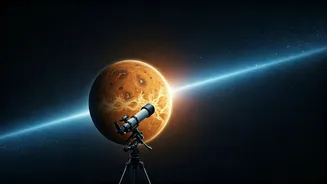
The 'proof' mentioned in the headline wasn't easy to obtain. Venus is perpetually covered by a thick blanket of sulfuric acid clouds, making visual observation of its surface from Earth impossible. For centuries, its rotation period was a complete mystery. The breakthrough came with the advent of radar technology. In the 1960s, scientists bounced radar signals off Venus from Earth-based radio telescopes. By analysing the Doppler shift in the returning signals, they could measure the speed and direction of the surface's rotation. Later, missions like NASA's Magellan spacecraft (1990-1994) used powerful radar to map over 98% of the planet's surface in stunning detail. By tracking surface features over time, Magellan confirmed the planet’s bizarrely slow, retrograde spin with incredible precision.
Theories For A Twisted Past
So, why is Venus so different? The leading theory points to a violent and chaotic past. One major hypothesis suggests that early in the solar system's history, Venus was struck by a massive planet-sized object. Such a colossal impact could have not only slowed its original rotation to a near-standstill but actually reversed it. Another theory involves the planet's incredibly thick atmosphere, which is 90 times denser than Earth's. Some models suggest that powerful atmospheric tides, driven by the Sun's immense gravity, could have acted as a brake over billions of years, slowing the planet's rotation and eventually flipping it. It's also possible a combination of these and other factors contributed to Venus's current state.
Earth's Twisted Sister
Venus is often called Earth's 'sister planet' because it's similar in size, mass, and composition. But the similarities end there. Its surface temperature is hot enough to melt lead, and the atmospheric pressure is equivalent to being 900 metres deep in the ocean. The strange rotation is another key difference that highlights how two similarly-formed planets can evolve into drastically different worlds. Studying Venus helps scientists understand planetary formation and what makes a planet habitable—or, in Venus's case, a scorching hellscape.