



A Glimpse into Alien Skies
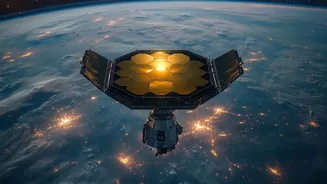
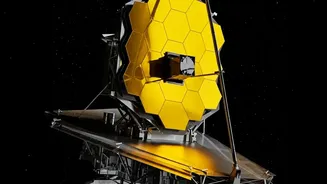
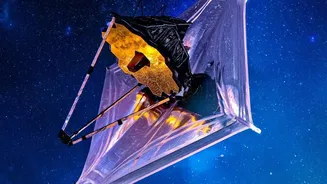
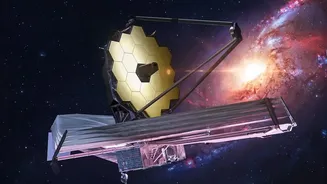
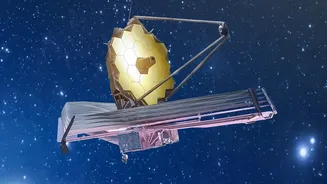
In the vast darkness of space, humanity's most powerful eye, the James Webb Space Telescope (JWST), has peered into the skies of alien worlds and found something incredibly familiar: water. Recent observations have provided compelling evidence for atmospheres
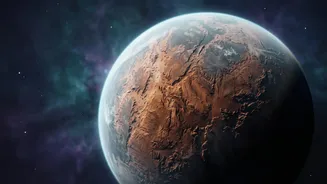
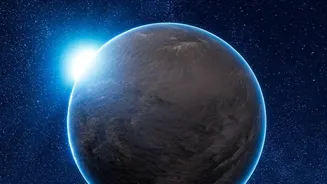
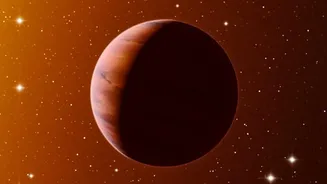
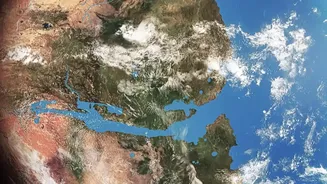
on rocky planets far beyond our solar system. One such world, GJ 486 b, located 26 light-years away, shows intriguing hints of water vapour. While scientists are cautious, this detection on a rocky planet is a major breakthrough, as previous water discoveries were primarily on large gas giants unsuitable for life as we know it. Another planet, 55 Cancri e, has also been a target, with researchers confirming it has a substantial atmosphere, though its scorching temperatures make it a 'hell planet' with a likely magma ocean. These findings are transforming the search for life from a theoretical exercise into an observational one.
The Power of Infrared Vision
How can a telescope see the air of a planet light-years away? The magic lies in a technique called transit spectroscopy. As an exoplanet passes in front of its host star from our perspective, a tiny fraction of the starlight filters through the planet's atmosphere. The JWST’s sensitive infrared instruments, like the Near-Infrared Spectrograph (NIRSpec) and Mid-Infrared Instrument (MIRI), capture this light. Different gas molecules in the atmosphere absorb specific wavelengths, or colours, of light. Water, carbon dioxide, and methane each leave a unique chemical fingerprint on the starlight's spectrum. By analysing these missing slivers of light, astronomers can deduce the chemical makeup of the planet’s air. It's a cosmic detective story where the clues are written in light, allowing us to study worlds we can never physically visit.
Why 'Rocky Super-Earth' Matters
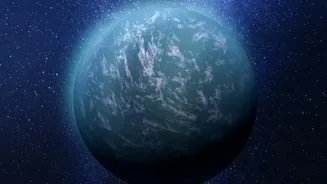
The terms 'super-Earth' and 'rocky' are crucial here. A super-Earth is a class of planet more massive than Earth but lighter than ice giants like Neptune. They are incredibly common in our galaxy, yet our own solar system curiously lacks one. The 'rocky' designation is the game-changer. For life to exist as we understand it, it needs a solid surface or a liquid ocean to call home. While astronomers have found water on gas giants before, these massive planets lack a solid surface. Discovering water vapour—a key ingredient for life—on a planet with a solid, rocky composition is a huge leap. It confirms that the building blocks for a habitable world can and do exist on planets similar in nature to our own, even if the specific examples found so far are too hot to support life.
A World of Caution
While the detection of water vapour is exciting, scientists are careful not to jump to conclusions. For planets like GJ 486 b, which orbits a cool red dwarf star, there's a chance the water signal isn't from the planet at all. Red dwarfs can have cool 'starspots' on their surface that contain water vapour, which could create a signal that mimics a planetary atmosphere. Researchers are working on follow-up observations to confirm the water's origin. In the case of 55 Cancri e, the planet is so hot that its surface is likely a molten magma ocean. Its atmosphere is probably not one it was born with, but a 'secondary' atmosphere being constantly replenished by gases bubbling out of the lava. This makes it a fascinating world to study planetary geology, but not a candidate for life.
The Search Continues
These discoveries, even with their caveats, are profoundly important. They prove that the JWST has the power to detect atmospheres on smaller, rocky worlds, a feat that was impossible with previous telescopes. Each detection provides a crucial data point, helping scientists understand how rocky planets form and whether they can hold onto their atmospheres in harsh stellar environments. The focus now shifts to using these same techniques to study other rocky planets, particularly those that orbit within their star's 'habitable zone'—the temperate region where liquid water could potentially exist on a planet's surface. The findings from worlds like GJ 486 b and 55 Cancri e serve as a vital roadmap, refining the search for a true Earth 2.0.