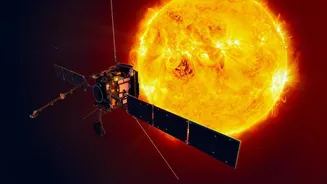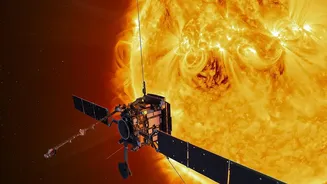

In the vast theatre of space, two advanced missions are performing a carefully choreographed dance to study our star. India's Aditya-L1 and the European Space Agency's Proba-3 are teaming up, providing a powerful, dual perspective on the Sun.
India’s Sentinel at L1
Launched
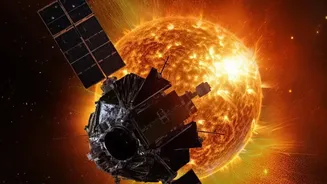
in September 2023, Aditya-L1 is ISRO's first dedicated solar observatory, a landmark mission for Indian space science. It is strategically positioned at the Sun-Earth Lagrange point 1 (L1), about 1.5 million kilometres from Earth. This unique vantage point allows for a continuous, uninterrupted view of the Sun, free from eclipses or occultations. Aditya-L1 is equipped with seven sophisticated payloads designed to observe the Sun’s outermost layers, the photosphere, chromosphere, and the corona. Its primary instrument for this collaboration is the Visible Emission Line Coronagraph (VELC). The VELC is a coronagraph, an instrument that blocks the blinding light from the Sun's main disk to study the much fainter atmosphere, or corona, that surrounds it. This allows scientists to track the origin of major solar events like Coronal Mass Ejections (CMEs).
Europe’s Artificial Eclipse in Space
The ESA's Proba-3 mission, launched in December 2024 aboard an Indian PSLV rocket, is a marvel of engineering and a world-first in precision formation flying. It consists of two separate spacecraft that fly in a precise alignment, about 150 metres apart. One spacecraft, the 'Occulter', positions itself to cast a perfect shadow onto the other, the 'Coronagraph', effectively creating a long-lasting artificial solar eclipse. This innovative technique allows its primary instrument, ASPIICS, to observe the Sun's inner corona with unprecedented clarity, closer to the solar limb than most other instruments can manage. While a natural eclipse on Earth lasts for minutes, Proba-3 can maintain this formation for up to six hours per orbit, giving scientists an extended, high-resolution look at the corona's mysterious inner workings.
Two Views Are Better Than One
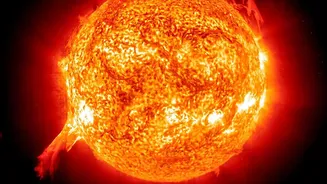
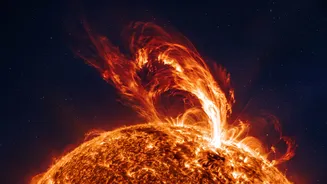
The synergy between Aditya-L1 and Proba-3 lies in their different but complementary methods of observation. Aditya-L1’s VELC provides a constant, wide-angle view from the L1 point, using spectroscopy to measure properties like the temperature and density of the plasma in the corona. It excels at catching the very first moments of an eruption as it leaves the Sun. Proba-3’s ASPIICS, with its artificial eclipse, provides incredibly sharp, detailed images of a CME's shape and structure as it expands through the inner corona. By combining the 'what' (spectroscopic data from VELC) with the 'where' (imaging data from ASPIICS), scientists can build a much more complete, three_dimensional picture of solar events. This dual_method approach allows for cross_checking measurements of a CME's mass, density, and energy, lending greater confidence to the scientific findings.
A Powerful Scientific Collaboration
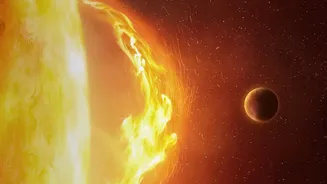
This partnership has already borne fruit. In a study led by researchers at the Indian Institute of Astrophysics (IIA) in Bengaluru, scientists combined data from both missions to analyse two CMEs observed in September 2025. The joint analysis provided a clearer understanding of how these massive eruptions of plasma and magnetic fields evolve just after they leave the Sun, a critical phase that was difficult to study with previous instruments. Understanding the early evolution of CMEs is vital for improving space weather forecasts. These solar storms, when directed at Earth, can disrupt satellite operations, communication networks, and even power grids. The success of this joint observation campaign highlights the growing importance of international cooperation in space science and reinforces the partnership between ISRO and ESA.