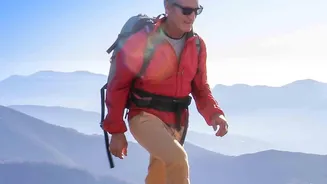







The Deliberate Scan of the Hiker
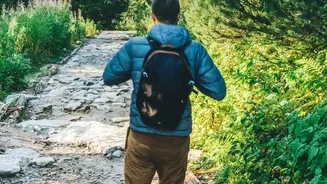
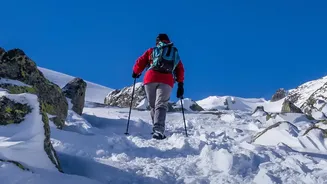
Hiking is an exercise in measured, forward-thinking awareness. The pace is slow enough to allow for conscious decision-making: where to place a foot to avoid a slippery root, how to shift your weight for an upcoming incline, or which path to take at a fork.
The hiker’s attention is broad and restorative. Psychologists refer to the effect of nature on the brain as Attention Restoration Theory, where natural stimuli like rustling leaves and flowing water provide a 'soft fascination'. This allows the brain's directed attention, the kind we exhaust with screens and daily decisions, to recover. The focus is less on immediate, high-consequence threats and more on a steady, meditative scanning of the path ahead, promoting a calm, clear state of mind.
The Rapid Read of the Skateboarder
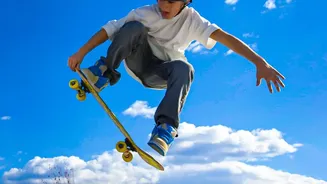
Skateboarding demands a completely different kind of attention: a rapid, high-stakes analysis of the immediate environment. A skateboarder doesn’t just see a sidewalk; they see a mosaic of cracks, pebbles, and uneven surfaces, each a potential disaster. Their focus is sharp and predictive, constantly calculating speed and trajectory to navigate obstacles in real time. This isn't a relaxed scan but a state of hyper-vigilance. Over time, skateboarders develop a unique way of seeing the world, where benches, ledges, and stairs are reinterpreted as 'affordances'—opportunities for movement and expression. This mindset requires constant problem-solving and rewires the brain for complex motor control and spatial geometry.
Two Kinds of 'Flow State'
Both activities can induce a 'flow state', that feeling of being completely immersed in the moment. However, the nature of that flow differs significantly. For a hiker, flow is often a low-arousal, meditative state where rhythm and breathing sync up over a long duration, and the mind feels clear and expansive. It's born from endurance and sustained focus. For a skateboarder, flow is a high-arousal state of intense concentration. It arises when the challenge is just hard enough to demand full engagement, silencing internal chatter and distorting the sense of time. While the hiker finds flow in the steady rhythm of the journey, the skater finds it in the split-second execution of a trick or maneuver.
Training the Body’s Awareness
These different attentional demands train proprioception—the body’s sense of its position in space—in distinct ways. Hiking enhances a conscious, deliberate awareness of body position by forcing the core and stabilizing muscles to constantly adjust to uneven ground. It’s a slow, steady calibration. Skateboarding, on the other hand, develops a subconscious, lightning_fast proprioceptive response. The need to make constant micro_adjustments on a moving board hones reflexes and builds a powerful, intuitive connection between the brain and body. This is why skaters can often land complex tricks that seem to defy conscious thought; their bodies have learned to react instantly, without waiting for deliberate instruction.
Perception, Risk, and Reality
Ultimately, the key difference comes down to the perception of risk. A misstep while hiking might lead to a twisted ankle or a muddy knee. For a skateboarder, the same small miscalculation—hitting a tiny stone—can result in a serious fall. This constant, elevated level of consequence fundamentally alters how the brain processes the environment. Studies have even shown that fear can change our perception of terrain; participants standing on a skateboard at the top of a hill judged it to be significantly steeper than those standing on a stable box of the same height. The hiker’s brain can afford to relax, while the skateboarder’s must remain on high alert, creating two powerful but fundamentally different mental disciplines.