








A Planet on an 8-Day Schedule
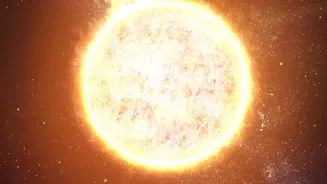
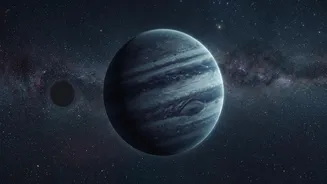
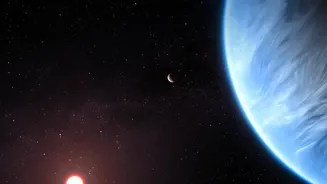
About 1,000 light-years from Earth, a star known as TOI-2535 is circled by a massive planet, TOI-2535 b. Discovered by NASA's Transiting Exoplanet Survey Satellite (TESS), this planet is a 'hot Jupiter'—a gas giant similar in size to our own Jupiter,
but orbiting its star in a scorching-hot 8.25 days. For years, astronomers detected it using the transit method: watching for the tiny, regular dip in starlight as the planet passed in front of its star from our perspective. This celestial alignment is a gift to planet hunters, allowing them to confirm a planet's existence and its orbital period. For a while, TOI-2535 b was a textbook case, with TESS observing its reliable crossings from 2019 onwards.
The Unreliable Clock
But the clockwork started to falter. Scientists noticed the transits were not perfectly periodic. The planet began arriving at its designated crossing point hours early, or sometimes hours late. The deviation was dramatic, with swings of up to six hours from the predicted schedule. Then, as the observations continued into 2026, the transits grew shorter and shallower before the planet seemed to disappear entirely. In March 2026, when TESS looked for TOI-2535 b, it was a no-show. The planet had, from our point of view, vanished. But it wasn't gone; its ghostly absence was actually a clue.
Gravity's Unseen Hand
In astronomy, such anomalies are rarely mistakes. They are often signs of something unseen. The phenomenon of a planet's transit time being pushed and pulled is known as Transit Timing Variation, or TTV. It happens when the gravity of another planet in the same system tugs on the transiting planet, subtly altering its orbit. Think of it like two runners on a track; if they are close enough, the presence of one can affect the pace of the other. The massive TTVs of TOI-2535 b were a dead giveaway that it was not alone. The planet's 'disappearance' was the final confirmation. It hadn't been destroyed; its orbit had been tilted.
A Wobbling Top Reveals a Hidden World
The explanation lies in a stunning display of orbital dynamics. Researchers, led by a team at UCLA, concluded that a second, massive planet—likely at least the mass of Saturn—is orbiting nearby. The two giant planets are so close that their gravitational interactions are incredibly strong, causing their orbits to wobble like spinning tops. This effect, called precession, caused the orbital plane of TOI-2535 b to tilt away from our line of sight. Over seven years, astronomers watched its path shift from crossing the star's middle to grazing its edge, and finally, missing the star entirely. This is the first time a planet orbiting a single star has been observed ceasing to transit due to this effect.
A New Cosmic Laboratory
The discovery does more than just solve a mystery; it opens a new window into how planetary systems evolve. Hot Jupiters like TOI-2535 b, which orbit so close to their stars, are a puzzle. How did they get there? The presence of its massive neighbour suggests TOI-2535 b may have slowly spiraled inward, rather than being violently flung into its current orbit. This makes the TOI-2535 system an unusual and valuable laboratory for studying planetary migration and the complex gravitational dances that shape distant solar systems. The 'missing' planet has revealed far more than it ever could by simply staying on schedule. And the story may not be over; researchers predict TOI-2535 b will wobble back into our line of sight in 30 to 50 years.