


More Than Just Calories
On Earth, a meal is a source of energy, comfort, and social connection. In the isolation of a multi-year Mars mission, these qualities become even more critical. Astronauts face immense psychological stress, and the simple act of enjoying a good meal can
be a powerful tool for boosting morale. Researchers know that “menu fatigue,” or getting tired of the same limited options, is a serious risk that can lead to astronauts eating less, potentially causing nutritional deficiencies and weight loss. Therefore, the food system for Mars must not only be nutritious but also palatable, varied, and enjoyable to combat the monotony of deep space travel. It's a complex balance of nutrition, psychology, and logistical reality.
The Five-Year Shelf Life Problem
A round trip to Mars could take two to three years, and resupply missions are not an option. This means that any pre-packaged food brought from Earth must remain safe, tasty, and, most importantly, nutritionally stable for up to five years. Over time, vital nutrients like vitamins C, A, and E degrade, which could compromise astronaut health on a long journey. Scientists are tackling this by developing advanced preservation and packaging techniques, like pressure-assisted thermal sterilization, to lock in nutrients and quality for longer periods. But even with these innovations, carrying enough pre-packaged food for an entire mission is impractical due to mass and volume constraints.
The High-Tech Space Garden
The most promising solution is to grow food in space. This not only provides fresh, nutrient-rich produce but also offers psychological benefits for the crew. NASA's Veggie and Plant Habitat experiments on the International Space Station (ISS) have already successfully grown crops like lettuce, tomatoes, radishes, and chile peppers. These space gardens use hydroponic (water-based) or aeroponic (mist-based) systems, eliminating the need for soil and conserving precious water, which can be recycled. Specialised pink-hued LED lights provide the specific wavelengths plants need to thrive in microgravity. Beyond just salads, researchers are studying crops like potatoes, soybeans, and even dwarf plum trees as potential staples for a Martian diet.
Zero-Waste and On-Demand Meals
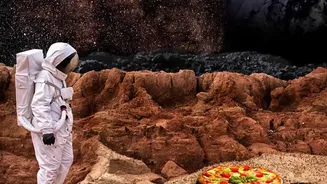
To supplement fresh crops and pre-packaged meals, scientists are exploring revolutionary technologies like 3D food printing. This system would use shelf-stable powders of starches, proteins, and fats, stored in cartridges with a potential shelf life of decades. By combining these base ingredients, a 3D printer could create a wide variety of meals on-demand, customised for each astronaut's nutritional needs and preferences. This technology promises not only variety and personalised nutrition but also a significant reduction in food waste, a critical factor on a resource-limited mission. Companies are already using this NASA-spurred technology to print foods like pizza and decorated cookies on Earth.
Beyond Plants: Protein from Air
Another futuristic solution involves creating protein from the air itself. The European Space Agency (ESA) is testing a system that uses microbes, electricity, and air to create a protein-rich powder called Solein. For space applications, the system would be adapted to use urea from recycled astronaut urine as a nitrogen source. Other research is looking into bioreactors that could cultivate protein sources like algae or yeast, and even cellular agriculture to produce lab-grown meats. These systems could provide a sustainable, on-demand source of essential protein, further reducing reliance on supplies from Earth.