

In the vast expanse of the cosmos, some of the most enigmatic objects are not quite stars, but not quite planets. New findings from NASA are shaking up our understanding of these 'failed stars' and their wild, unpredictable weather.
Meet the Brown Dwarf
Imagine an object that
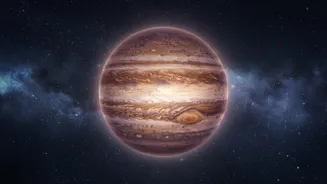
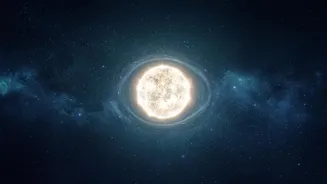
forms like a star from a collapsing cloud of gas and dust, but never quite accumulates enough mass to ignite and shine. That's a brown dwarf. These celestial bodies are more massive than planets like Jupiter but fall short of the threshold needed to sustain nuclear fusion in their cores. Often called 'failed stars', they drift through space as dimly glowing balls of gas, heated from within, but without a parent star to orbit. Their unique position between star and planet makes them fascinating subjects for astronomers. By studying them, we can learn about both stellar formation and the atmospheric dynamics of gas giants, since their atmospheres are easier to observe than those of exoplanets obscured by the glare of a host star.
NASA’s New Eye in the Sky
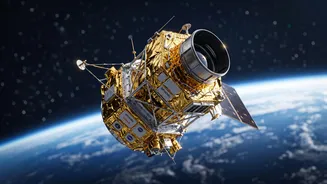
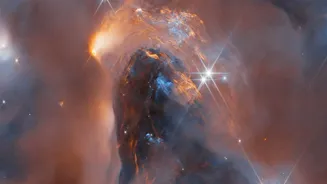
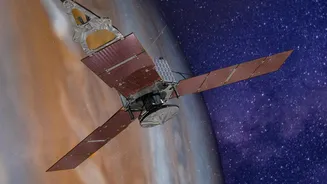
Enter NASA's SPHEREx telescope, which stands for Spectro-Photometer for the History of the Universe, Epoch of Reionization, and Ices Explorer. Launched in March 2025, this space observatory is on a mission to map the entire sky in 102 different colors of infrared light. While invisible to the human eye, this infrared spectrum is a powerful tool. It allows scientists to cut through cosmic dust and detect the chemical signatures of molecules in the atmospheres of distant objects. By creating these detailed, multi-wavelength maps of the cosmos, SPHEREx is providing an unprecedented view of hundreds of millions of galaxies and stars, including thousands of previously unstudied brown dwarfs.
What We Thought We Knew
For years, scientific models of brown dwarfs have been based on observations from a relatively small number of these objects. The prevailing theory was that as brown dwarfs age and cool, their atmospheres go through predictable changes. It was believed that hotter brown dwarfs have clouds made of rock-like silicates and iron. As they cool, these heavy clouds were expected to sink deeper into the atmosphere, allowing gases like methane to become dominant in the upper layers. This process, known as the L-T transition, was thought to explain the observed changes in their brightness and color over time. These models assumed a relatively uniform evolution, where temperature was the main driver of atmospheric change.
A Storm of Surprising Data
The new study, based on SPHEREx's observations of 37 nearby brown dwarfs, challenges this tidy picture. While the data confirmed the presence of water, methane, carbon monoxide, and carbon dioxide, it also revealed a surprising amount of diversity. The transition from cloudy to clear, methane-rich atmospheres wasn't as straightforward as predicted. According to Zafar Rustamkulov, the study's lead author, 'No two brown dwarfs are alike. Even at the same temperature, their spectra look quite distinct'. The study found that existing models struggle to match the real-world data, especially during the cloudy transitional phases. It appears factors beyond just temperature, such as gravity and elemental composition, play a much larger role in their atmospheric behavior than previously thought.
Why This Cosmic Weather Report Matters
This discovery is more than just a cosmic curiosity; it has profound implications for our understanding of planets beyond our solar system. Brown dwarfs serve as natural laboratories for studying the atmospheric physics of gas giants. Understanding the complex interplay of clouds, chemistry, and circulation on these isolated worlds helps scientists refine the models they use to interpret the atmospheres of exoplanets. As study coauthor J. Davy Kirkpatrick noted, these findings are a 'call to action to explore even more of these dark worlds'. The complexity seen in brown dwarfs suggests that the atmospheres of giant exoplanets are likely just as varied and unpredictable. The challenge of forecasting weather on these bizarre objects highlights how much we still have to learn about planetary climates across the universe.