



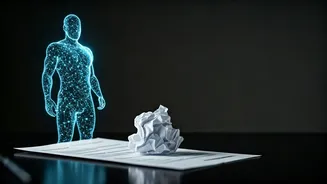


The AI Advantage: A Perfect First Draft
Let's be clear: AI resume builders are incredibly useful for getting started. They excel at the laborious parts of CV writing that often lead to procrastination. These tools can parse a job description in seconds, suggesting relevant keywords to help
your application pass through Applicant Tracking Systems (ATS) — the initial automated screening used by many companies. Studies show that 75% of resumes are rejected by ATS before a human ever sees them, making this keyword optimisation crucial. AI provides a solid structure, ensures consistent formatting, and can help you overcome writer's block by generating a first draft in minutes, a process that could otherwise take hours. It’s an efficient way to get a clean, organised template covering your experience, skills, and education.
Where the Robots Falter: Generic and Soulless
The biggest drawback of a purely AI-written CV is its lack of personality. Recruiters are becoming adept at spotting the tell-tale signs of AI: overly formal language, repetitive sentence structures, and an abundance of generic buzzwords like "results-driven" or "team player" without specific context. In one survey, nearly nine in ten recruiters said they could identify an AI-generated resume at least some of the time. These tools often produce content that feels hollow and fails to tell a compelling career story. Worse, AI can sometimes make factual errors or "hallucinate" details, inventing or exaggerating skills and accomplishments that are not accurate. This can damage your credibility before you even get to the interview stage.
The Human Touch: Weaving Your Career Story
This is where you come in. Your most valuable contribution to your CV is the narrative. AI can list job duties, but it can't explain the 'why' behind your career moves or the 'so what' of your achievements. A human touch is needed to transform a list of responsibilities into a story of growth and impact. For example, instead of a generic AI-generated bullet point, you can add quantifiable achievements: "Increased sales by 23% in Q3" provides concrete evidence of your success that AI cannot invent. It’s also up to you to convey soft skills like strategic thinking, relationship-building, and empathy — qualities that AI struggles to articulate but employers highly value. A 2024 survey revealed that 68% of hiring managers prefer a personal voice over a perfectly polished but impersonal AI output.
Your Step-by-Step Guide to AI-Assisted CVs
The key is to use AI as a co-pilot, not an autopilot. Start by letting an AI tool generate a draft based on your experience and the target job description. This gives you a strong, ATS-friendly foundation. Then, take over the editing process with a critical eye. First, fact-check everything. Remove any exaggerated or inaccurate claims. Next, rewrite the professional summary and experience sections in your own voice, infusing them with personality. Replace vague buzzwords with specific, quantifiable achievements. Finally, tailor the document for every single application. This final step is non-negotiable and shows a genuine interest that a generic, mass-produced CV never can. A human must always perform the final review to ensure the document is authentic and error-free.