






The Fiery Challenge of Return
Plummeting through an atmosphere at hypersonic speeds creates an incredible amount of friction and heat. For decades, space agencies have relied on rigid, ablative heat shields that burn away in a controlled manner to protect the precious cargo inside.
Think of the Apollo capsules returning from the Moon. These shields work, but they have a fundamental limitation: size. A heat shield can’t be wider than the rocket carrying it into space. This size constraint limits how much mass you can land on another planet. The bigger and heavier the payload—say, a habitat for human astronauts on Mars—the bigger the brake you need to slow it down. The thin Martian atmosphere makes this problem even harder, as it offers less drag to begin with.
An Inflatable Solution
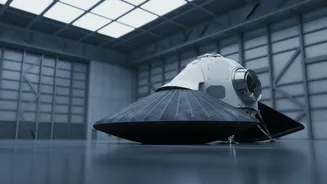
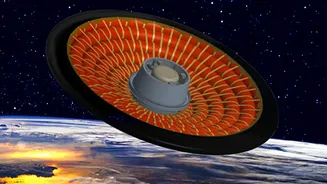
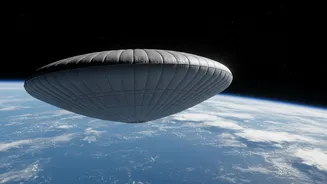
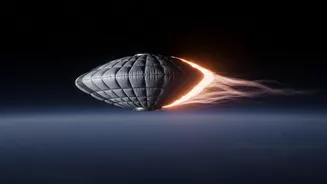
Enter the Hypersonic Inflatable Aerodynamic Decelerator, or HIAD. Developed by NASA over the last two decades, this technology is exactly what it sounds like: a heat shield that can be packed down tightly for launch and then inflated in space just before it’s needed. The most prominent demonstration of this concept is the LOFTID (Low-Earth Orbit Flight Test of an Inflatable Decelerator) mission, which successfully tested a 6-meter-wide shield in 2022. The inflatable design breaks the tyranny of the rocket fairing. Instead of being limited in size, these shields can be deployed to create a much larger surface area, acting as a more effective atmospheric brake.
More Than Just a Balloon
This is no simple party balloon. The inflatable structure is made of a stack of rings, or tori, woven from synthetic polymer fibers that are, by weight, significantly stronger than steel. This structure is then covered by a flexible thermal protection system—a multi-layered blanket of advanced ceramic and insulating fabrics designed to withstand temperatures reaching nearly 3,000 degrees Fahrenheit (about 1,650 Celsius). When the time comes, the system inflates with nitrogen gas, becoming rigid enough to maintain its shape against the intense forces of re-entry. The result is a large, stable, and surprisingly durable shield that uses drag to do most of the hard work of deceleration.
Bigger Landings, Bolder Missions
The primary advantage of inflatable shields is their ability to enable bigger missions. By creating more drag, they allow spacecraft to slow down at higher altitudes where the atmosphere is thinner, reducing the peak heat and forces experienced. This is a game-changer for destinations like Mars. A larger aeroshell means NASA can land heavier payloads, such as the supplies and equipment needed for a human crew, and at higher-elevation sites that are currently inaccessible with traditional landing systems. Beyond Mars, this technology could be used for missions to Venus, Saturn's moon Titan, or for returning large components and samples to Earth more cost-effectively.
From Test Flights to the Red Planet
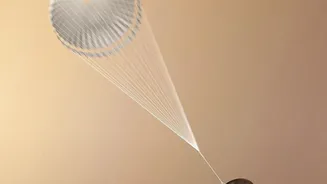
The successful LOFTID test proved that the technology could survive re-entry from orbital speeds, slowing from over 18,000 miles per hour to less than 80 mph before deploying its parachutes. This built on a series of earlier, smaller-scale tests. Now, space agencies in both the US and Europe are looking to scale the technology up for future missions. The European Space Agency is developing its own inflatable shield demonstrator, while NASA sees the technology as a key enabler for its Mars Sample Return mission and eventual human exploration of the red planet. This innovation could also find commercial applications, helping to recover and reuse rocket stages or return cargo from orbit.