
The Fine, Sharp Dust Problem
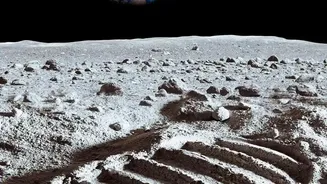
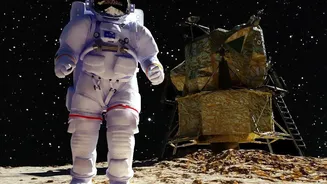
On Earth, dust is an annoyance. On the Moon, it's a serious hazard. Lunar dust, or regolith, isn't like terrestrial soil. Billions of years of micrometeorite impacts, without wind or water to smooth the edges, have created microscopic particles that are
as sharp as glass. This abrasive material clings to everything due to electrostatic charge and poses a multi-pronged threat. It can wear through the layers of spacesuits, clog seals, and scratch helmet visors. If tracked inside a habitat, these tiny, sharp particles can be inhaled, potentially causing long-term lung damage similar to silicosis. Scientists are developing new materials and electrostatic shielding technologies to repel the dust and keep astronauts and their equipment safe.
Powering Through the Long Night
A lunar day-night cycle is about 28 Earth days long, meaning any settlement will face a roughly 14-day period of darkness and extreme cold. This long night makes solar power, while viable during the day, a difficult primary energy source without a massive energy storage solution. Storing enough power in batteries or fuel cells to last for two weeks is a significant mass and technology challenge. Consequently, NASA and its partners are seriously investigating nuclear fission as a more reliable alternative. A small, portable fission reactor could provide a steady 40 kilowatts of power, enough to run life support and experiments continuously, regardless of whether the sun is shining. These systems are being designed to operate for at least a decade, offering a dependable backbone for a permanent base.
The Invisible Threat of Radiation
Without a protective magnetic field or thick atmosphere, the lunar surface is constantly bombarded by two types of dangerous radiation: a steady stream of galactic cosmic rays (GCRs) and unpredictable bursts from solar particle events (SPEs). This radiation can damage human DNA, increasing the long-term risk of cancer, and can also disrupt sensitive electronics. Protecting astronauts is paramount. The simplest solution is to use mass as a shield. This could involve building habitats underground or piling several metres of lunar regolith on top of surface structures to absorb the radiation. For solar storms, designated 'storm shelters' with extra shielding inside the habitat would provide a safe haven for astronauts to wait out the event.
Learning to Live Off the Land
Shipping every litre of water, breath of air, and drop of rocket fuel from Earth is unsustainable and astronomically expensive. For a moon base to be viable, it must learn to 'live off the land' through a process called In-Situ Resource Utilization (ISRU). The most critical resource is water ice, which has been discovered in permanently shadowed craters near the Moon's poles. This ice can be mined and then processed. By splitting the water molecules (H2O), astronauts can produce breathable oxygen for life support and hydrogen for rocket propellant. This would effectively turn the Moon into a refuelling station for deeper space missions, dramatically lowering the cost and complexity of exploring the solar system.
Building a Home on the Moon
Habitats on the Moon must be more than just shelters; they need to be resilient fortresses. They must protect their inhabitants from radiation, micrometeoroid impacts, and wild temperature swings that can go from 127°C in the day to -173°C at night. Launching heavy, pre-fabricated modules from Earth is one option, but an exciting alternative is to use the Moon's own resources for construction. Agencies are exploring technologies like 3D printing using lunar regolith as the primary building material. This could allow for the construction of large, radiation-shielding structures, landing pads, and other infrastructure without having to launch all the materials from Earth, representing a major step toward self-sufficiency.
The Psychology of Isolation
The technical challenges are immense, but the human element is just as critical. Living in a small, confined space with a handful of other people, millions of kilometres from home, presents profound psychological challenges. The risk of interpersonal conflict, depression, anxiety, and monotony is very real. Space agencies study crews in analogous environments, like Antarctic research stations and submarines, to understand how to select compatible crews and support their mental health. Ensuring astronauts have meaningful work, downtime for leisure, privacy, and a reliable connection to loved ones back on Earth will be crucial for mission success and the well-being of the explorers who will call the Moon their temporary home.