



A Telescope Spanning Two Continents
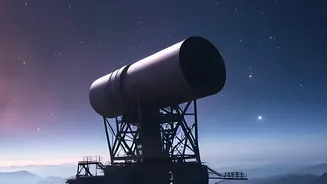
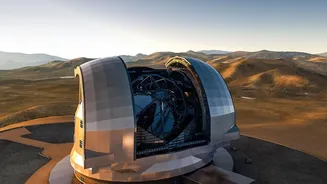
The Square Kilometre Array (SKA) isn't a single telescope but a groundbreaking network of thousands of antennas spread across two continents, operating as one colossal instrument. Headquartered in the UK, its physical components are located in the radio-quiet
deserts of South Africa and Western Australia. The name comes from its original ambition: to create a total collecting area of one square kilometre, making it the most sensitive radio telescope ever conceived. This global collaboration involves more than a dozen countries, including a significant contribution from India, all working together to build a machine capable of exploring fundamental questions about our universe.
Listening to the Universe's Ancient Echoes
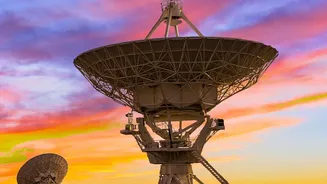
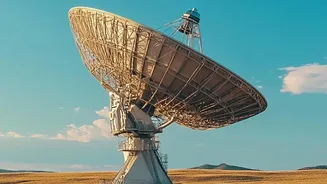
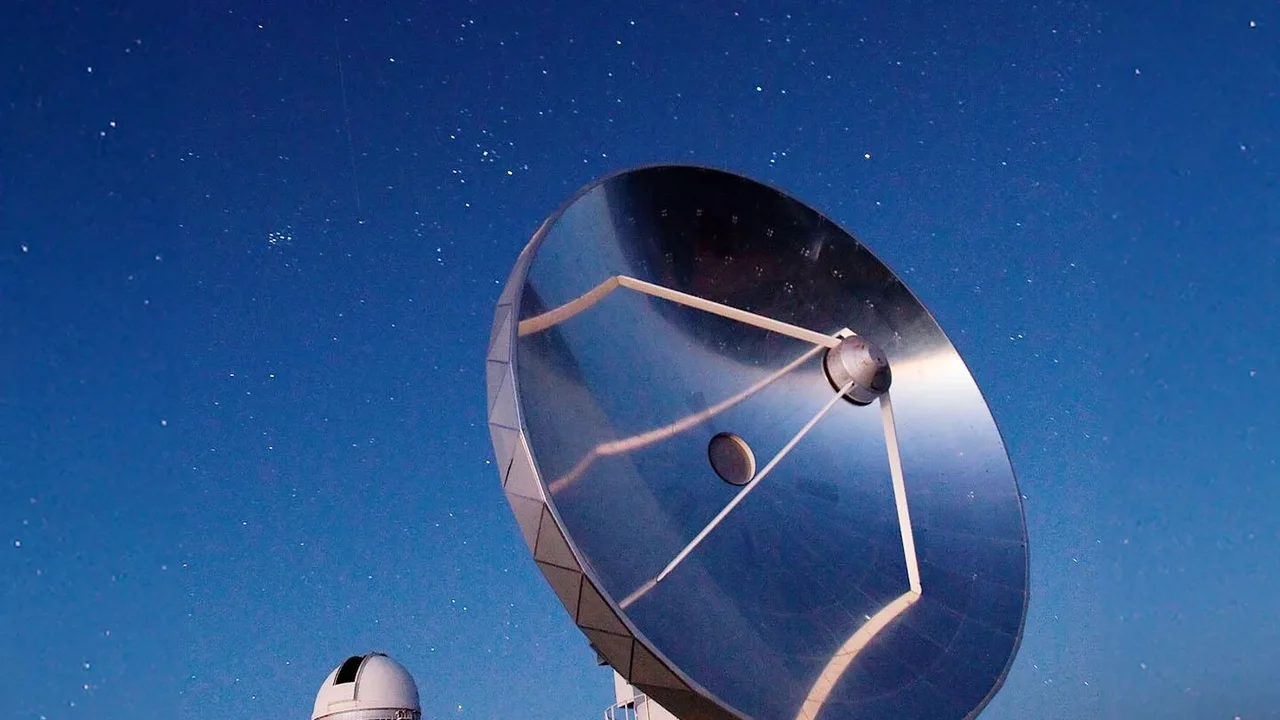
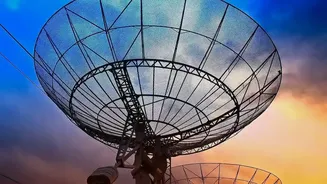
Unlike optical telescopes that see visible light, the SKA's dishes and antennas are designed to detect faint radio waves. Many cosmic events, especially those from the very distant past, don't emit much visible light but do leave faint radio signatures. Think of it like tuning a radio to find a weak, distant station drowned out by static. The SKA is designed to pick up these incredibly feeble signals, which have been travelling across the cosmos for billions of years. To achieve this, the project uses two types of arrays: SKA-Mid in South Africa consists of 197 classic dish antennas, while SKA-Low in Australia uses over 131,000 smaller, Christmas-tree-like antennas. The different designs are optimized to capture different frequency ranges, giving astronomers a more complete picture.
The Quest for the Cosmic Dawn
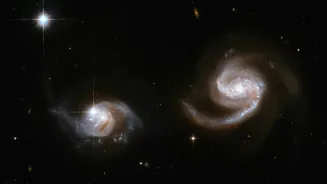
One of the SKA’s primary missions is to study a period known as the Epoch of Reionization, or the ‘Cosmic Dawn’. This was the era, roughly 13 billion years ago, when the very first stars and galaxies began to form, and their light started to ionize the neutral hydrogen gas that filled the universe. Scientists are hunting for the specific radio signal emitted by this neutral hydrogen, known as the 21-cm line. As the universe expanded, this signal was stretched to much lower frequencies, and detecting it today is incredibly challenging. By creating a 3D map of this hydrogen, the SKA will essentially be able to watch the first galaxies light up the cosmic darkness, revolutionizing our understanding of how the universe evolved.
India's Pivotal Role in the 'Neural Network'
India is a full member of the SKA project, contributing Rs 1,250 crore and playing a crucial role in its development. Indian scientists and engineers, led by the National Centre for Radio Astrophysics (NCRA) in Pune, have taken the lead in developing the Telescope Manager. This complex software system is essentially the 'brain' or 'neural network' of the entire observatory. It will be responsible for controlling and monitoring the thousands of antennas, issuing commands for observations, and ensuring the whole array works in perfect synchrony. This vital contribution places Indian expertise at the very heart of the SKA's operations, building on the country's strong legacy in radio astronomy from facilities like the Giant Metrewave Radio Telescope (GMRT).
An Unprecedented Flood of Data
Observing the universe with such sensitivity will generate an astronomical amount of data—petabytes per day, more than the entire global internet traffic of today. Processing this deluge of information is one of the project's greatest challenges. Powerful supercomputers located at Science Processing Centres in Cape Town and Perth will be needed to correlate the signals from every antenna and filter out interference. This interference is a major hurdle; the cosmic signal is billions of times weaker than the radio noise from sources on Earth and even from our own galaxy. Sophisticated algorithms, many using machine learning, are being developed to clean the data and extract the faint cosmological whispers from the overwhelming noise, turning raw signals into scientific discovery.