



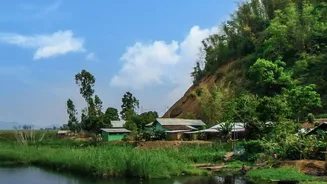
What Are the Floating Islands?
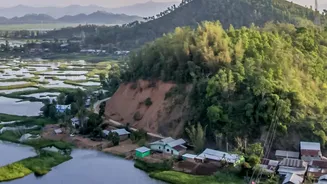
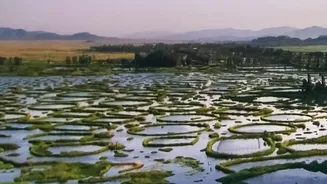
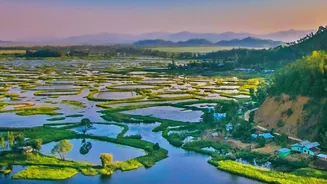
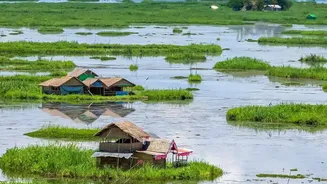
The defining feature of Loktak, Northeast India's largest freshwater lake, is its 'phumdis'. These are not islands in the traditional sense, but dense, buoyant masses of vegetation, soil, and organic matter that have accumulated over centuries. They float
on the lake's surface, with the majority of their mass hidden underwater like an iceberg. These phumdis are remarkably stable, supporting the weight of huts and serving as a base for the local fishing community. The locals have lived on them for generations, creating a unique water-based lifestyle. From the air, the lake appears dotted with green rings and patches, many of which are man-made circular phumdis used for fishing.
The World’s Only Floating National Park
The largest of these phumdis, covering around 40 square kilometres in the lake's southern part, is home to the Keibul Lamjao National Park. It holds the distinction of being the only floating national park in the world. This extraordinary sanctuary was established in 1977 primarily to protect the endangered Sangai deer, a subspecies of the brow-antlered deer found only in Manipur. Often called the 'dancing deer' for its delicate gait on the spongy marshland, the Sangai is the state animal and a symbol of cultural pride. Once thought to be extinct in 1951, a small population was rediscovered, leading to conservation efforts that have helped the numbers grow, though the species remains endangered.
Experiencing Life on the Water
To truly understand Loktak, you must experience life on a phumdi. Several families now run homestays directly on the floating islands, offering a unique opportunity to live alongside the fishing community. These accommodations are typically basic bamboo huts, but provide an unparalleled immersion into the local way of life. Waking up to the mist rising off the water and watching fishermen paddle their boats through the channels is an unforgettable experience. A morning boat ride is essential, offering the best chances to see the lake's ecosystem come alive and, with some luck, spot the elusive Sangai deer near the park's edges.
How to Plan Your Visit
The gateway to Loktak Lake is Imphal, the capital of Manipur. The Bir Tikendrajit International Airport in Imphal is well-connected to major Indian cities. From Imphal, Loktak is about 45-50 kilometres away, a drive of around 1.5 hours to the town of Moirang, which lies on the lake's edge. You can hire a taxi from Imphal or take a shared taxi to Moirang. From Moirang, local transport or a pre-arranged pickup from your homestay can get you to the various viewpoints and boat jetties. Note that some sources suggest an Inner Line Permit (ILP) may be required for domestic tourists to enter Manipur, so it is crucial to check the latest regulations on the official government portal before you travel.
Best Time to Go and What to Do
The ideal time to visit Loktak Lake is between October and March. During these months, the weather is cool and pleasant, the skies are clear, and visibility is excellent for sightseeing and wildlife spotting. The monsoon season, from roughly May to September, is best avoided due to heavy rains that can disrupt travel. Key activities include taking an early morning boat safari in Keibul Lamjao National Park to see the Sangai, visiting Sendra Island for panoramic views of the lake, kayaking through the phumdi channels, and exploring the local fishing villages to understand their unique culture. For a bit of history, the INA Memorial at Moirang, which commemorates Subhash Chandra Bose's Indian National Army, is also a worthwhile visit.