





The Blueprint of Disease
To understand how to fight a disease, scientists first need a detailed map of the enemy. In many cases, the enemy is a malfunctioning protein. Proteins are complex, three-dimensional molecules that perform countless essential tasks in our bodies. When
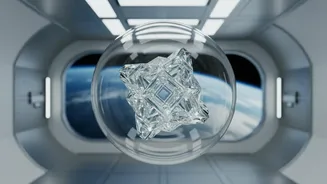
they are misshapen or don't work correctly, they can cause diseases ranging from cancer to muscular dystrophy. Many modern drugs work by targeting these specific proteins, fitting into them like a key into a lock to correct their function. To design the perfect 'key,' however, drug developers need a crystal-clear picture of the 'lock.' This is where protein crystallisation comes in. Scientists encourage proteins to grow into solid, ordered crystal lattices, which can then be analysed with X-rays to reveal their precise 3D structure.
The Problem with Gravity
Growing perfect protein crystals on Earth is incredibly challenging for one fundamental reason: gravity. As the crystals form in a solution, gravity causes sedimentation, pulling the denser, growing crystals down. It also causes convection, where tiny fluid movements disturb the delicate growth process. These forces result in crystals that are often small, flawed, and have an irregular internal structure. When analysed, these imperfect crystals produce a blurry or incomplete picture of the protein's structure, making it difficult for scientists to design effective drugs. It’s like trying to build a key for a lock when you only have a fuzzy photograph to work from. This limitation has been a significant hurdle in drug development for decades.
A Laboratory in Orbit
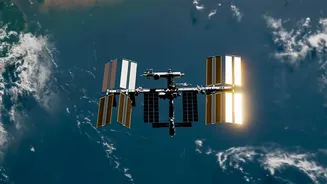
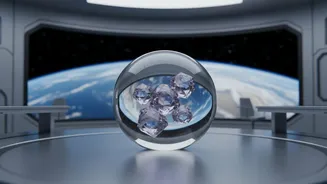
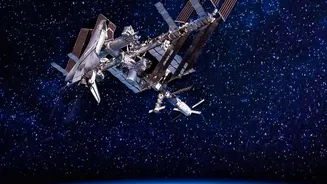
The International Space Station (ISS) offers a radical solution. In its microgravity environment, the forces of sedimentation and convection are almost entirely eliminated. Protein molecules in a solution can assemble into crystals slowly and methodically, without being pulled or jostled. This allows them to grow much larger and with a more perfect, uniform internal structure. Astronauts aboard the ISS conduct experiments for pharmaceutical companies and research institutions, growing crystals of medically important proteins. These near-perfect crystals are then returned to Earth for analysis, providing scientists with the high-resolution structural blueprints they have been seeking. It turns out that a 'do not disturb' environment is exactly what these delicate molecules need to reveal their secrets.
Success Stories from Space
This out-of-this-world research is already yielding life-changing results back on Earth. A prominent example involves the cancer immunotherapy drug, pembrolizumab (Keytruda). Research on the ISS helped scientists at Merck understand how to formulate the drug so it could be given as a quick, simple injection under the skin instead of a lengthy intravenous infusion. This has dramatically improved the quality of life for cancer patients by reducing treatment time from hours to just minutes. Similarly, research into a protein associated with Duchenne Muscular Dystrophy (DMD), an incurable genetic disorder, has led to the development of a potential treatment that is now in clinical trials. Studies have also targeted proteins involved in heart disease, salmonella, and Parkinson's disease, showing the broad potential of this orbital research.