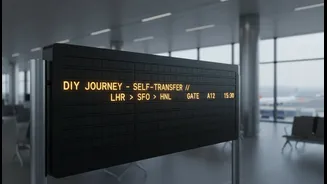









What is a Self-Transfer, Really?
Unlike a traditional connecting flight booked on a single ticket, a self-transfer (or 'unprotected connection') involves purchasing two or more separate flights to get to your final destination. You might pair a long-haul flight on a major carrier with
a shorter leg on a budget airline. While this can lead to significant savings, the airlines involved see each flight as an independent journey. This means there's no coordination for baggage handling or check-in. If your first flight is delayed, the second airline has no obligation to rebook you for free; you're simply a no-show. The responsibility for making the connection, and the financial risk if you don't, rests entirely with you.
The High-Stakes Gamble of a Tight Connection
The biggest risk with a self-transfer is a missed connection. According to one study, a delay of just 30 minutes can cause 40% of self-connecting passengers to miss their onward flight. Unlike a protected connection where the airline must get you to your final destination, a self-transfer leaves you to buy a new, often expensive, last-minute ticket. The process itself is also far more involved. You must typically exit the secure area, collect any checked luggage, go to the departures hall, check in for your next flight, re-check your bags, and clear security all over again. This can be a time-consuming gauntlet, especially in large, unfamiliar airports or when you need to change terminals. You may also need to pass through immigration, which requires having the correct visa for the transit country.
Why Isn't There a Standard Already?
Airlines and airports do use a metric called Minimum Connection Time (MCT), which is the shortest interval required to transfer between flights on a protected, single-ticket itinerary. This official time is calculated based on factors like airport layout, the distance between terminals, and security procedures. However, MCTs are designed for seamless transfers where baggage is checked through and passengers often stay within the secure area. They do not account for the complex, multi-step process of a self-transfer. Since self-transfers involve separate contracts with different airlines, there is no single entity responsible for creating or enforcing a standardized buffer time. Each airport's layout and procedures are unique, making a one-size-fits-all number difficult to establish without industry-wide collaboration.
The Case for a Clear Minimum Self-Transfer Buffer
The lack of official guidance leaves travelers guessing, often with costly consequences. Airports should publish a recommended 'Self-Transfer Minimum Buffer Time' for both domestic and international connections. This figure wouldn't be a guarantee but a realistic guideline based on average times to deplane, collect bags, navigate the airport, and clear security. It would empower travelers to make informed decisions instead of relying on vague rules of thumb. Establishing this standard would acknowledge the growing reality of self-transfer travel and provide a much-needed layer of transparency. It would force a clearer distinction between a 'legal' connection time for single-ticket journeys and a 'realistic' buffer for DIY itineraries, reducing stress and the likelihood of missed flights.
What Travelers Can Do in the Meantime
Until official guidance exists, caution is your best strategy. Most experts suggest a buffer of at least three to four hours for a self-transfer, and even more for international journeys or at large, busy airports. Traveling with only a carry-on is a major time-saver, as it allows you to skip the baggage claim and re-check process. Before booking, study the airport layout online, noting the terminals for your arrival and departure. Finally, consider travel insurance policies that specifically cover missed connections on separate tickets, but always read the fine print to understand the conditions.