
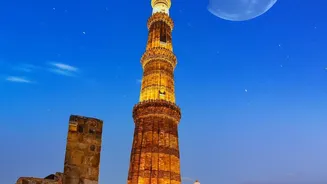
A Perfect Cosmic Shadow Play
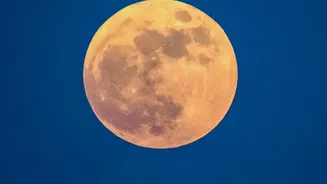
At its core, a lunar eclipse is a simple and beautiful alignment of three celestial bodies: the Sun, Earth, and Moon. It can only happen during a full moon, when the Moon is on the opposite side of the Earth from the Sun. When the three align perfectly,
the Earth casts a massive shadow into space, and the Moon passes directly through it. This shadow has two parts. The penumbra is the fainter, outer shadow, where sunlight is only partially blocked. The umbra is the dark, inner shadow, where direct sunlight is completely obscured. The type and visual drama of the eclipse depend entirely on which part of the shadow the Moon travels through.
Not All Eclipses Are Equal
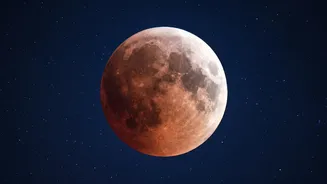
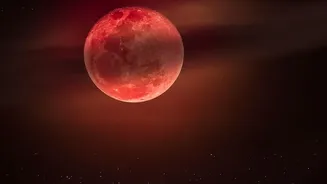
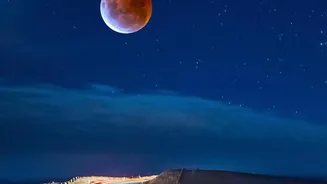
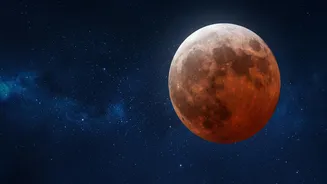
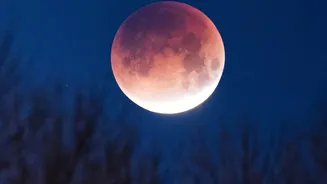
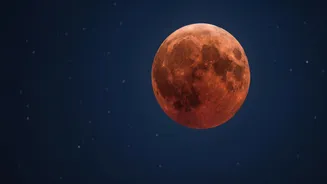
There are three main types of lunar eclipses. The most subtle is a penumbral eclipse, where the Moon only passes through Earth's faint outer shadow. To a casual observer, the Moon might just appear slightly dimmer than usual. Next is a partial lunar eclipse, where a portion of the Moon enters the Earth's dark umbra. This looks like a dark bite is being taken out of the lunar surface. The most spectacular is a total lunar eclipse. This occurs when the entire Moon passes through the umbra. It is during this phase of totality, which can last from half an hour to over an hour, that the Moon takes on its famous reddish colour.
The Secret Behind The Crimson Glow
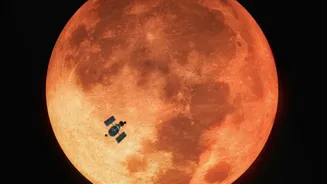
If the Earth is completely blocking the Sun, why doesn't the Moon just disappear into blackness? The answer lies in our planet's atmosphere. While the Earth itself blocks the direct light, its atmosphere extends beyond the planet and acts like a giant lens or filter. Sunlight streams through this atmospheric ring, which filters out shorter-wavelength colours like blue and violet. This phenomenon is called Rayleigh scattering, and it’s the same reason our sky is blue and our sunsets are red. The atmosphere scatters the blue light away, but the longer-wavelength red and orange light passes through. This reddish light is then bent, or refracted, towards the Moon, illuminating its surface with a coppery glow. In a sense, during a total lunar eclipse, all of the sunrises and sunsets happening on Earth are projected onto the face of the Moon.
From Fear to Fascination
The brightness and exact shade of red can change with each eclipse. It depends on factors like the amount of dust, clouds, or volcanic ash in Earth's atmosphere at the time. A dustier atmosphere can lead to a deeper, darker red moon. Throughout history, this sudden reddening of the Moon was often seen as a terrifying omen, with many cultures creating stories of demons or dragons swallowing the celestial body. In ancient India, the demon Rahu was believed to be responsible. But as our understanding of celestial mechanics grew, fear gave way to fascination. The Blood Moon is no longer a portent of doom but a celebrated event. It’s a beautiful, large-scale demonstration of physics, reminding us of the intricate and predictable dance of our solar system and the unique properties of our own atmosphere. It’s a chance to witness the cosmos in action, painted in the light of a thousand sunsets.