




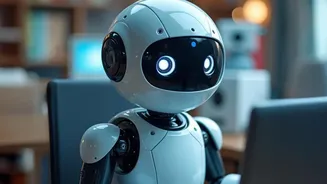
The rise of AI has sparked widespread anxiety about job losses. But a leading voice from IIT Madras offers a different view, suggesting a future where AI acts more like a co-worker than a replacement, fundamentally transforming how we work.
Beyond the Replacement Narrative
The conversation
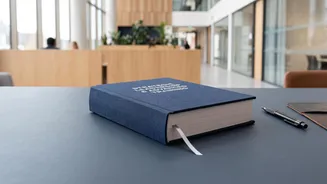
around artificial intelligence and jobs often defaults to a simple, alarming question: 'Will a robot take my job?' While this concern is understandable, researchers from the Indian Institute of Technology (IIT) Madras argue that it's the wrong way to look at the issue. In a recent white paper from its Centre for Responsible AI (CeRAI), the institution proposes a more nuanced perspective. The paper, titled 'How AI Is Reconfiguring Work in India', suggests that AI is far more likely to automate specific tasks within a job rather than eliminate the entire role. This shifts the focus from outright replacement to a more complex reality involving augmentation, job redesign, and evolving responsibilities. According to the researchers, whether AI helps an employee or displaces them depends on a variety of factors, including the nature of the industry, the cost of the technology, and how companies choose to reorganise their work.
From Job Loss to Task Automation
The core idea presented by IIT Madras is to break down a job into its component parts. Most professions are not a single, monolithic activity but a collection of different tasks. AI may excel at the repetitive, data-heavy parts of a role, but struggle with tasks that require critical thinking, empathy, or complex problem-solving. For instance, in a call centre, an AI might handle routine customer queries, freeing up human agents to manage more complex and sensitive cases that require a personal touch. Similarly, in a factory, an AI system could inspect thousands of products for defects with incredible speed, while a human worker oversees the system and intervenes when something unexpected occurs. Professor Balaraman Ravindran, head of CeRAI, notes that most jobs have tasks that AI can perform, but that doesn't automatically mean the job disappears. It means the job itself changes.
The Human-AI Collaboration Model
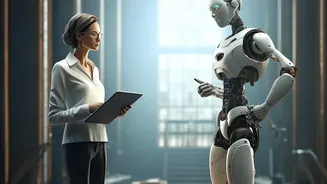
The IIT Madras paper outlines two primary ways humans and AI will likely collaborate. In the first model, AI performs the majority of the tasks, and the human's role shifts to one of validation and oversight, acting as a final quality check. In the second, more common model, the human remains in the driver's seat, using AI as a powerful tool to enhance their efficiency and decision-making. Think of a financial analyst using AI to process vast datasets in minutes, allowing them to focus on interpreting the findings and developing strategy. Or a software developer using an AI assistant to write boilerplate code, freeing them up to focus on system architecture and creative problem-solving. This 'human-in-the-loop' approach treats AI as a partner that augments human capability, not a competitor that replaces it.
Skills for the New Workflow
This transformation of workflows means that the most valuable professional skills are also changing. As AI takes over more routine tasks, the demand for uniquely human skills will rise. These include critical thinking, creativity, strategic decision_making, and emotional intelligence. Furthermore, a new baseline of 'AI literacy' will become essential across almost every industry. Employees will need to understand how to work alongside AI systems, how to prompt them effectively, and how to interpret their outputs critically. The challenge, as highlighted by the IIT Madras paper, is not just about preventing job losses but about redesigning roles and creating clear pathways for workers to acquire these new skills. This places a significant responsibility on both educational institutions and employers to invest in continuous training and upskilling initiatives.
The Road Ahead for India
The paper also introduces the concept of an 'AI—cost geography' in India, noting that the technology's adoption will not be uniform. Affordable , task—specific AI tools may become widespread among small and medium—sized businesses , while more advanced and costly systems might remain concentrated in large urban corporations . This uneven spread underscores the need for tailored policies and accessible training programs . Institutions like IIT Madras are actively working to address this , not only through research but by promoting AI awareness and education . The ultimate message is one of proactive adaptation . By focusing on how workflows are changing and what new skills are needed , India 's workforce can navigate the AI revolution not as a threat , but as an opportunity for growth and innovation .