




A Sudden, Startling Change
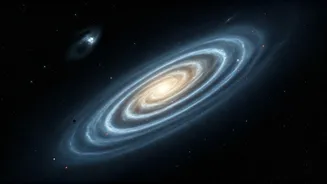
In late 2019, astronomers at the Zwicky Transient Facility in California noticed something unusual. The galaxy SDSS1335+0728, located about 300 million light-years away in the constellation Virgo, began to shine dramatically brighter than ever before.
For years, it had been an unremarkable, quiet galaxy. Suddenly, its core was emitting vast amounts of energy. This brightening didn't fade away like a typical supernova or a star being torn apart; instead, it has continued to grow in intensity for more than four years. This sustained and unprecedented change alerted scientists that they might be observing something truly historic.
What Does 'Waking Up' Even Mean?
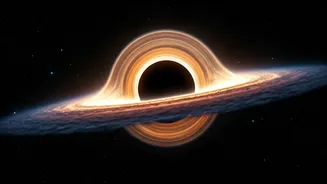
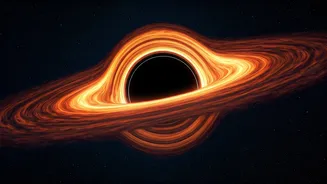
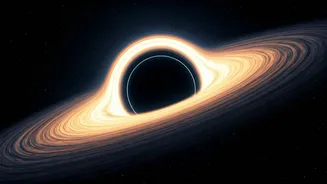
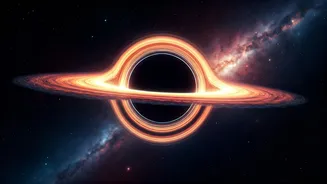
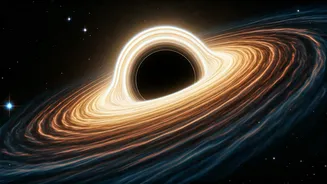
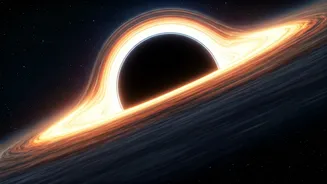
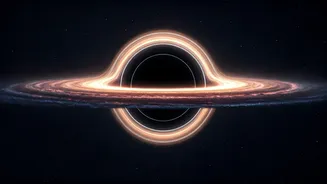
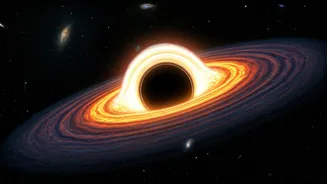
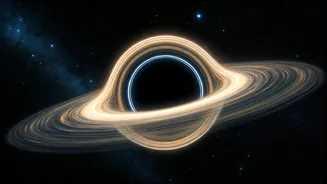
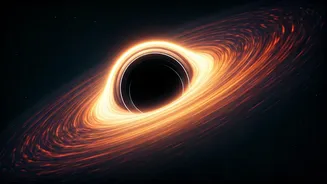
Most large galaxies, including our own Milky Way, have a supermassive black hole at their center. These cosmic behemoths, with masses hundreds of thousands or even millions of times that of our sun, are usually dormant, or 'sleeping'. They are not actively feeding on large amounts of material, which means they don't radiate much energy and are difficult to see directly. However, when a large supply of gas and dust becomes available—perhaps from a nearby star cloud or a cosmic collision—the black hole can 'wake up'. As this material spirals into the black hole, it forms a brilliantly hot and bright structure called an accretion disk. The immense energy released by this disk is what astronomers are now seeing from SDSS1335+0728, which has been newly classified as having an 'active galactic nucleus' (AGN).
The Galactic Detective Story
To confirm what was happening, an international team of astronomers led by Paula Sánchez Sáez from the European Southern Observatory (ESO) began a detailed investigation. They ruled out other possibilities for the sudden brightness, such as a tidal disruption event (TDE), where a star gets shredded by a black hole. TDEs typically only last for a few hundred days, but this galaxy's core is still brightening years later. Using data from multiple powerful instruments, including ESO's Very Large Telescope (VLT), they compared observations taken before and after the 2019 event. The data showed the galaxy was radiating much more light across ultraviolet, optical, and infrared wavelengths. Then, in February 2024, it also began to emit X-rays, further strengthening the case that the black hole had truly become active.
How 'Nearby' Is This Awakening Giant?
The headline's use of "nearby" is all about cosmic perspective. The galaxy SDSS1335+0728 is 300 million light-years away. This means the light from this event has taken 300 million years to reach our telescopes. While that sounds impossibly far, in the grand scheme of the universe, it's considered to be in our relative cosmic neighborhood. This proximity is a huge advantage for scientists. It allows them to study the awakening process in unprecedented detail, something that would be much harder with a more distant galaxy. There is absolutely no danger to Earth; instead, we have a front-row seat to one of the most fundamental processes in galactic evolution.
A New Window into the Cosmos
This event marks the first time astronomers have been able to observe the activation of a supermassive black hole in real-time. Before this, the transition from a dormant to an active phase was only a theoretical concept. Observing it as it happens provides a treasure trove of data that will help answer long-standing questions about how these giant black holes grow and how they influence the galaxies they inhabit. Scientists are now planning follow-up observations with even more powerful tools, like the James Webb Space Telescope, to get a closer look at the gas dynamics around the black hole. It’s a rare opportunity to watch a galaxy’s core transform, providing insights that could reshape our understanding of the universe's life cycle.