



A Celestial Neighbourhood Watch
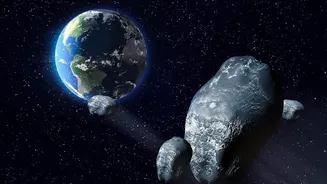
Our solar system is a busy place, filled with remnants from its formation 4.6 billion years ago. Among these are millions of asteroids, and some have orbits that bring them close to Earth. These are known as Near-Earth Objects, or NEOs. While most pose
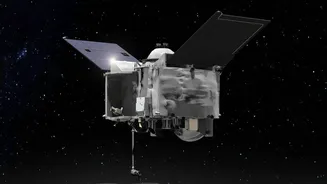
no danger, a small fraction are large enough to cause significant damage if they were to collide with our planet. This is where the concept of planetary defense comes in. It's a global effort to find, track, and characterise these asteroids to assess any potential impact risk. The goal isn't to create panic, but to build a comprehensive catalogue of our celestial neighbours, allowing scientists to calculate their trajectories for decades, or even centuries, into the future. By knowing what is out there, we can be prepared.
Finding a Speck in the Cosmos
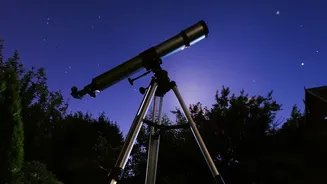
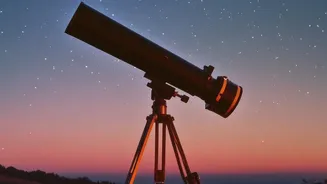
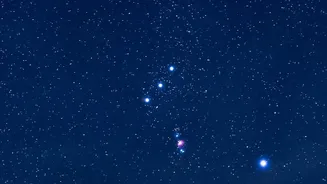
So, how do you find a relatively small, dark rock against the infinite blackness of space? It starts with survey telescopes repeatedly imaging large patches of the night sky. Computers then analyse these images, looking for tiny points of light that have moved relative to the fixed background of stars and galaxies. Once a candidate is flagged, a global network of observatories, including both professional and amateur astronomers, springs into action. They perform follow-up observations to gather more data points. Each new observation helps astronomers refine the asteroid's orbit with greater precision. Major programs like NASA's Planetary Defense Coordination Office work with facilities such as the Catalina Sky Survey and Pan-STARRS to lead this search. The new Vera C. Rubin Observatory is expected to revolutionise this field, discovering tens of thousands of new NEOs and providing an unprecedented census of our solar system.
The Invisible Threat of Radiation
Beyond the physical threat of an asteroid impact lies another, more constant danger: space radiation. This consists of high-energy particles that stream through space. It comes from two main sources: a constant shower of galactic cosmic rays (GCR) from distant events like supernovae, and sudden bursts of solar particles from flares on our own Sun. Here on the surface, Earth's magnetic field and atmosphere protect us from the worst of this radiation. However, this radiation poses a significant risk to astronauts in space and to the satellites our modern world depends on for communication, navigation, and weather forecasting. Intense solar storms can disrupt or damage satellite electronics, and in extreme cases, could even impact power grids on the ground.
Forecasting Cosmic Weather
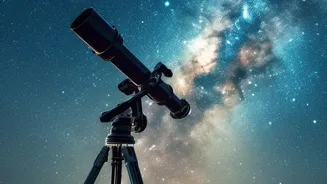
Telescopes are our primary tool for 'space weather' forecasting. While they don't see the radiation particles directly, they monitor the source. Optical, X-ray, and radio telescopes keep a constant watch on the Sun, looking for the tell-tale signs of a solar flare or a coronal mass ejection—a massive eruption of plasma and magnetic fields. By observing these events as they happen, scientists can predict if and when a wave of energetic particles will wash over Earth, giving satellite operators and power grid managers time to take protective measures. Other telescopes search the wider universe for the high-energy phenomena like gamma-ray bursts that produce cosmic rays, helping us understand this pervasive background radiation.
India's Eyes on the Sky
India plays an important role in this global scientific endeavour. Observatories across the country contribute to our understanding of the cosmos. For instance, the GROWTH-India Telescope in Ladakh, a collaborative effort between the Indian Institute of Astrophysics (IIA) and IIT Bombay, is part of an international network that tracks fast-moving objects like asteroids. Other key facilities include the Himalayan Chandra Telescope at the Indian Astronomical Observatory in Hanle, one of the world's highest observatories, and the Vainu Bappu Observatory in Kavalur. These telescopes not only hunt for asteroids but also contribute to broader research on cosmic events, adding a vital piece to the planetary defense puzzle and enhancing India's capabilities in space situational awareness.