





More Than Just the Longest Day
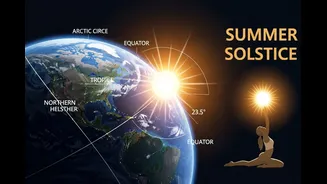
We all learn it in school: the summer solstice marks the longest day and shortest night of the year for the Northern Hemisphere. But what does that really mean? It’s a direct result of our planet’s tilt. Earth spins on an axis that is tilted by about
23.5 degrees relative to its path around the Sun. This tilt is why we have seasons. As we orbit the Sun, different parts of the Earth get more direct sunlight than others. The summer solstice is the peak of this tilt for our hemisphere, the day when the North Pole is angled most directly towards the Sun. Think of it as the planet taking its deepest 'lean-in' towards its star, bathing our half of the world in the maximum amount of daylight it will get all year.
The 'Geometric Instant' Explained
This is where the real buzz begins. The term 'geometric instant' refers to the single, fleeting moment when the Sun, from our perspective on Earth, reaches its northernmost point in the sky. It appears to pause directly over the Tropic of Cancer (the imaginary line at 23.5 degrees north latitude). This year, that precise moment will occur at 2:20 AM IST on June 21. For an instant, the Sun's northward journey across our sky halts before it begins its slow march south again, leading us toward autumn. It's a moment of perfect cosmic geometry, a peak in the sine wave of the seasons. Space enthusiasts and astronomers celebrate this not as a day-long event, but as a pinpoint in time, a testament to the beautiful, predictable mechanics of our solar system.
A Clockwork Universe
The ability to forecast this 'instant' down to the minute and second is what truly excites scientists and amateurs alike. It’s a powerful reminder that we live inside a giant, intricate clockwork system. The movements of planets and stars are governed by fundamental laws of physics, allowing us to understand and predict celestial events with incredible accuracy. This predictability is not just an academic curiosity. For centuries, it formed the basis of calendars, agriculture, and navigation. When we celebrate the solstice, we are participating in a tradition of observation that connects us to our earliest ancestors who looked to the sky and saw not chaos, but a reliable, recurring pattern.
Ancient Roots and Indian Significance
In India, this celestial event has been observed and revered for millennia. The summer solstice marks the transition to Dakshinayana, the six-month period when the Sun begins its apparent journey south. While Uttarayana (the northward journey) is often associated with auspicious beginnings, Dakshinayana holds its own spiritual significance, seen as a time for introspection and inner cultivation. Ancient observatories like the Jantar Mantar in Delhi and Jaipur are magnificent stone instruments built precisely to track the Sun's path and pinpoint moments like the solstice. These structures are a testament to India's deep-rooted astronomical heritage, blending scientific inquiry with cultural and spiritual practice.
Solstice and the Spirit of Yoga
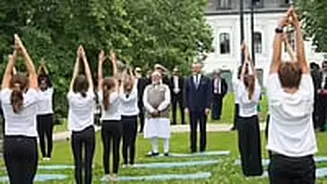
There's a very modern, and global, connection to the solstice that has its roots in India: International Yoga Day. The United Nations designated June 21 as the official day for this celebration, a date proposed by Prime Minister Narendra Modi. The choice was deliberate. As the longest day of the year, the summer solstice symbolises light, consciousness, and peak natural energy. Yoga, at its core, is a discipline aimed at uniting the body, mind, and spirit, and achieving a state of balance and heightened awareness. By aligning the global practice of yoga with this powerful solar event, the day serves as a beautiful metaphor for illumination and the potential for human consciousness to reach its own peak.