


What Exactly is Galangal?
Often called ‘Thai ginger’ or ‘Siamese ginger’, galangal is a rhizome—a type of underground stem—from the same family as ginger and turmeric. Known as ‘kha’ in Thai, it's a cornerstone of Southeast Asian cuisine, particularly in Thailand, Indonesia, and Malaysia.
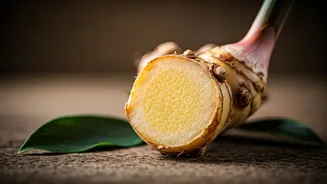
While it looks a bit like its more famous cousin, galangal is a distinct ingredient with its own unique properties. It typically has smoother, paler skin and can have white, pink, or yellow flesh. Unlike ginger, its flesh is incredibly hard and woody, which means it needs to be handled differently in the kitchen.
The Galangal vs. Ginger Showdown
This is the most common point of confusion for home cooks. While they are related, galangal and ginger are not interchangeable. Substituting one for the other will dramatically change the flavour of your dish. Ginger offers a warm, spicy, and slightly sweet heat. Galangal, on the other hand, delivers a completely different profile. Its flavour is sharp, peppery, and intensely citrusy with pine-like, earthy notes. Some even describe its refreshing aroma as slightly medicinal, in a good way, reminiscent of a pine forest. In terms of texture, ginger's flesh is softer and can be easily grated, while galangal’s dense, fibrous nature means it must be thinly sliced or pounded into a paste.
Galangal’s Starring Roles in Thai Food
If you've eaten classic Thai soups or curries, you have definitely tasted galangal. It is a non-negotiable ingredient in two of Thailand's most famous soups: Tom Yum (a hot and sour soup) and Tom Kha Gai (a creamy chicken and coconut soup). In these dishes, slices of galangal are added to the broth to infuse it with their signature aromatic flavour; the tough pieces are usually not eaten. Galangal is also a fundamental component of Thai curry pastes, including red, green, and yellow varieties. It is pounded together with other ingredients like lemongrass, chillies, and kaffir lime leaves to form the flavour base that gives these curries their depth and complexity.
How to Prepare and Use Galangal
Because of its tough texture, galangal requires specific preparation. The most common method for soups is to cut the rhizome into thin, coin-like slices. This maximizes the surface area, allowing its flavour to infuse into the broth. Remember to advise guests not to eat these woody slices.
For curry pastes or marinades, galangal must be pounded. To make this easier, it’s best to finely chop or thinly slice it before putting it in a mortar and pestle. This breaks down the tough fibres and releases its potent aromatic oils. For some dishes like salads, you can use very finely minced galangal, but be aware that its pungent flavour can be overpowering if the pieces are too large.
Finding and Storing This Aromatic Gem
You can find fresh galangal in most Asian markets and some larger supermarkets with a good international section. Look for firm rhizomes that are free of mould or soft, shrivelled spots. Fresh, unpeeled galangal can be stored in the refrigerator for up to two or three weeks. For longer storage, the freezer is your best friend. The best way to freeze it is to wash and dry the rhizome, slice it into thin rounds, and freeze them in a single layer on a tray before transferring them to a freezer bag. This prevents them from clumping together into an unusable block and will keep for several months. You can also find dried galangal slices and powder, but the fresh or frozen forms offer a far superior flavour.