

The Tyranny of Distance
The fundamental problem with talking to Mars is the speed of light. Nothing travels faster. Depending on where Earth and Mars are in their orbits, a radio signal can take anywhere from four to 24 minutes to travel one way. This means a round-trip conversation—asking
a question and getting a reply—can take up to 48 minutes. It’s a delay that makes real-time control impossible. You can't joystick a rover or have a conversation. Every message is like a carefully sent postcard, arriving long after it was written. This unavoidable lag forces a complete rethink of how missions are planned and executed, a challenge that engineers have cleverly solved for robots, but which becomes a life-or-death problem when humans are involved.
How Robots Phone Home
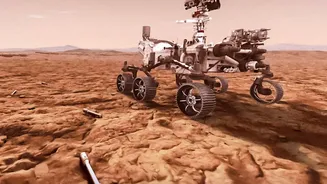
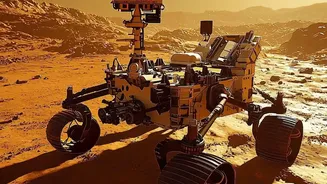
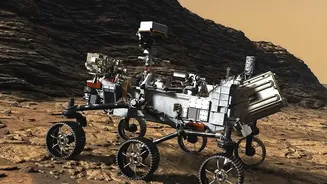
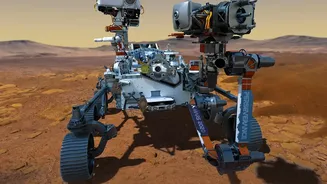
Our robotic explorers on Mars are designed for patience and autonomy. Mission controllers on Earth don't fly them in real time; they upload a day's worth of commands and wait for the results. This communication is handled by NASA's Deep Space Network (DSN), a global system of massive radio antennas in California, Spain, and Australia that ensures we always have a line of sight to our spacecraft as the Earth turns. To save power and increase data rates, rovers often don't talk directly to Earth. Instead, they send their data to orbiters like the Mars Reconnaissance Orbiter, which act as relays, using their larger antennas to beam the information back home. This system is efficient but slow, designed for robots that can wait for instructions without consequence.
When Humans are on the Line
Putting humans on Mars changes the entire equation. You can't ask astronauts to wait 40 minutes for a response from Mission Control during a medical emergency or a critical system failure. The communication delay that is an operational puzzle for rovers becomes a profound risk for human life. Studies in analog missions have shown that communication lags increase stress and the likelihood of errors for both the crew and the controllers on the ground. Beyond emergencies, the psychological toll of isolation is magnified by the inability to have a simple, real-time conversation with loved ones back on Earth, which research indicates can negatively affect performance. For a human mission, communication isn't just about data; it's a lifeline that, if delayed, could be catastrophic.
The Great Martian Blackout
Approximately every 26 months, Mars and Earth enter a period called solar conjunction, where the Sun is directly between the two planets. During this time, which can last for a couple of weeks, the hot, ionized gas spewing from the Sun's corona interferes with and blocks radio signals. Mission planners anticipate this and put their spacecraft into a safe, autonomous mode, halting most science and refraining from sending new commands until the blackout passes. While robotic missions can simply wait it out, a multi-week communication blackout for a crewed mission would mean the astronauts are completely on their own, unable to call for help or receive guidance during a potential crisis.
The Future is Made of Lasers
To solve these immense challenges, NASA is developing new technologies. The most promising is Deep Space Optical Communications (DSOC), which uses lasers instead of radio waves. Lasers can transmit data at rates 10 to 100 times higher than current radio systems, which would allow for high-definition video streaming from Mars. A recent demonstration on the Psyche spacecraft successfully transmitted data over vast distances, proving the concept's viability. While laser communication still travels at the speed of light and doesn't solve the time delay, the increased bandwidth is crucial for complex human missions. Engineers are also exploring concepts like a dedicated satellite relay network around Mars, which could provide continuous coverage and potentially reduce blackout times during solar conjunctions.