




Along Maharashtra's Konkan coast lies a fortress that was never conquered. Rising from the Arabian Sea, Murud-Janjira is a testament to incredible military engineering and has a history that surprisingly connects to a famous Bollywood family.
An Island Fortress in the Arabian Sea
Murud-Janjira
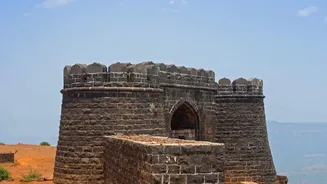
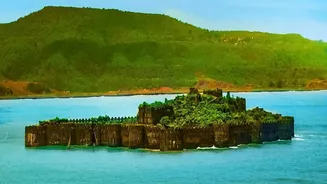
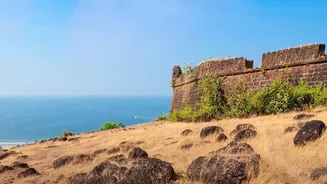
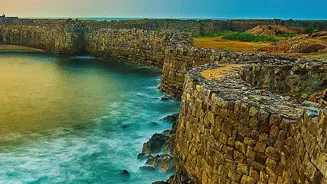
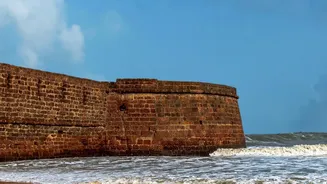
is an imposing sea fort located on an oval-shaped rock island off the coast of Murud, a fishing village in Maharashtra's Raigad district. Situated about 165 kilometres south of Mumbai, its name comes from the Arabic word 'Jazeera', which means 'island'. For centuries, this fortress was a symbol of power, controlling maritime trade routes along India's western coast. Its massive stone walls, which rise up to 40 feet, and its strategic location made it a formidable stronghold. The only way to reach it is by a short boat ride from the nearby Rajapuri jetty, a journey that depends on calm seas and fair weather.
The Unconquered Stronghold of the Siddis
The fort’s story begins in the 15th century with local fishermen who built a wooden structure to fend off pirates. Recognizing its strategic value, it was later captured and rebuilt into a formidable stone fortress in the 16th century under the authority of the Ahmadnagar Sultanate. It soon became the capital of the Siddis, rulers of African descent who established a powerful, independent princely state. The Siddis were brilliant naval commanders and warriors, and under their rule, Janjira became legendary. Despite numerous attacks from the Portuguese, the British, and even the formidable Marathas led by Chhatrapati Shivaji Maharaj, the fort was never conquered by military assault. Its 'unconquered' status is a core part of its enduring legacy.
An Architectural and Military Marvel
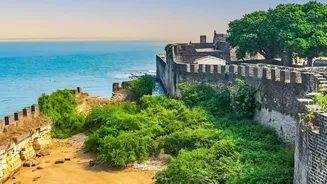
The genius of Murud-Janjira lies in its design. The main gate is cleverly hidden and only becomes visible at close range, a feature designed to confuse attackers. Inside its sprawling 22-acre expanse, the fort contained a self-sufficient world. There are ruins of a palace, a mosque, and two large freshwater lakes, which remarkably provided drinking water despite the fort being surrounded by the salty sea. Janjira was once armed with over 500 cannons. Today, many still remain, including three legendary cannons named 'Kalaal Baangadi', 'Chavri', and 'Landa Kasam', renowned for their size and firepower. A stone carving at the entrance depicting a tiger trapping six elephants symbolised the Siddis' bravery.
The Surprising Bollywood Connection
The link to a famous actor stems from the royal lineage of the Siddis, who ruled Janjira State until it merged with India in 1948. The rulers held the title of 'Nawab'. The connection points to veteran actress Amrita Singh. While Singh herself was born in Delhi to a Sikh father and a politically connected mother, Rukhsana Sultana, it is through her extended family that the link to royalty exists, though not directly to the Nawabs of Janjira. The headline hints at a connection to a 'birthplace', and while the fort itself wasn't a birthplace for the actor, the princely state of Janjira and its ruling family are part of the complex tapestry of Indian nobility into which families like hers are woven through various historical ties.
Visiting Janjira Today
Today, Murud-Janjira is a protected monument and a major tourist attraction, drawing visitors who come to marvel at its history and architecture. Tourists can take sailboats from Rajapuri jetty for the short crossing. Typically, visitors are given a limited amount of time to explore the fort's ruins before the boat makes its return journey. The best time to visit is from October to March, when the weather is pleasant and the seas are calm. A trip to the fort offers a panoramic view of the Arabian Sea and a tangible link to a fascinating chapter of Indian history, where a small island kingdom held its own against mighty empires.