




Why Venus Still Fascinates Scientists
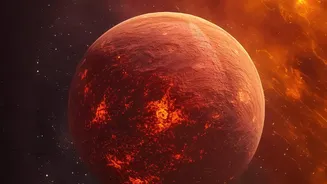
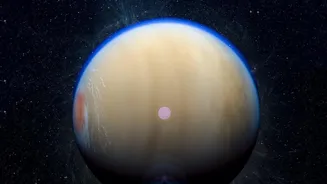
Despite being our closest planetary neighbour, Venus remains one of the most mysterious places in the solar system. It's a tale of a world gone wrong. Scientists believe Venus may have once hosted liquid water oceans before a runaway greenhouse effect
turned it into a scorching hellscape, with surface temperatures hot enough to melt lead. Its atmosphere is over 90 times denser than Earth's and shrouded in thick clouds of sulfuric acid. Understanding how and why Venus transformed so dramatically offers a crucial natural laboratory for studying climate change, providing a cautionary tale for our own planet. This makes ISRO's upcoming mission, formally called the Venus Orbiter Mission, a vital quest for knowledge.
A Mission to Uncover Atmospheric Secrets
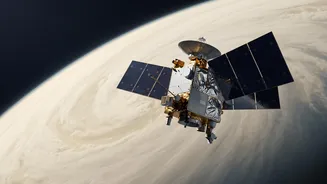
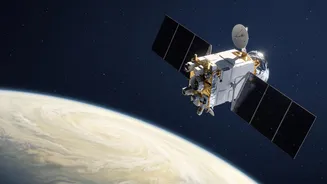
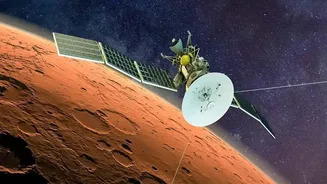
Formally approved by the Union Cabinet in September 2024, the Shukrayaan mission is scheduled to launch aboard a powerful LVM-3 rocket on March 29, 2028. After a 112-day journey, the orbiter is expected to enter a highly elliptical orbit around Venus. While the mission has several objectives, including mapping the surface with radar, a primary goal is to conduct a detailed study of the structure, composition, and dynamics of the Venusian atmosphere. With a science payload of about 100 kg distributed across roughly 19 instruments, Shukrayaan is equipped to perform a comprehensive chemical analysis of the planet's notorious clouds.
The Toolkit: Peering Through the Haze
To study cloud chemistry, you need a specialised set of tools that can identify different molecules and observe their behaviour. Shukrayaan will carry several key instruments for this purpose. One is the Venus Thermal Camera (VTC), designed to map the temperature of the cloud tops by measuring thermal emissions. This data helps scientists understand atmospheric dynamics and locate potential hotspots from volcanic activity below. Another is the Venus Cloud Monitoring Camera (VCMC), which will capture images in UV and visible light to study the planet's super-rotating cloud systems, atmospheric waves, and even look for lightning.
International Collaboration for Deeper Insights
A key instrument for atmospheric chemistry is VIRAL (Venus Infrared Atmospheric Gases Linker), a collaborative payload from Russia's Roscosmos and France's CNES. VIRAL is a spectrometer designed to measure the composition of the atmosphere above the clouds, providing crucial data on its chemical makeup. Spectrometers work by analysing light to identify the unique signatures of different gases. This, combined with other instruments like the Venus Atmospheric Spectropolarimeter (VASP) which studies cloud properties, will allow ISRO to build a detailed chemical profile of the atmosphere and search for trace gases that could offer clues about the planet's ongoing geological processes.
What the Data Will Tell Us
By gathering this unprecedented data, Shukrayaan aims to answer some of the biggest questions about Venus. The chemical and thermal data from the clouds will help refine models of its extreme greenhouse effect. The mission will also investigate how the solar wind interacts with the Venusian ionosphere, a process that likely contributed to the planet losing its water. Furthermore, the detailed atmospheric analysis could help investigate the controversial and tantalising possibility of phosphine gas, a potential biosignature that some scientists speculate could exist in the more temperate upper layers of the Venusian atmosphere. This makes the mission's findings critical for planetary science.