


Taming the Data Tsunami
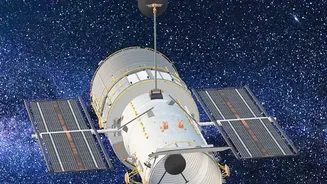
Modern observatories like the James Webb Space Telescope (JWST) and the retired Kepler Space Telescope generate staggering amounts of data—far more than human astronomers can sift through manually. NASA's Earth Observation System Data and Information
System archive has already surpassed 100 petabytes. This cosmic flood of information contains hidden clues about everything from the birth of galaxies to planets orbiting distant stars. The primary challenge has shifted from simply collecting data to analyzing it effectively. This is where AI excels. By training machine learning algorithms on vast datasets, scientists can automate the process of finding significant patterns and anomalies that would otherwise be missed.
Hunting for Hidden Worlds
One of the most exciting applications of AI in astronomy is the hunt for exoplanets. These are planets orbiting stars outside our solar system, and finding them is like spotting a firefly in a stadium full of spotlights. AI models, such as NASA's ExoMiner, are trained to detect the minuscule dip in a star's brightness that occurs when a planet passes in front of it—an event called a transit. This method has proven incredibly successful. In 2017, a collaboration between Google and NASA used AI to find two new exoplanets in Kepler data that had been previously overlooked. More recently, deep learning systems like ExoMiner and RAVEN have validated hundreds of new exoplanets, including rare and extreme worlds, by analyzing data from the TESS mission. These AI tools can process thousands of stars at once, a task that would take humans an impossible amount of time.
Smarter Spacecraft and Sharper Images
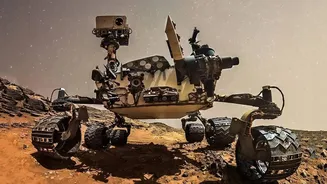
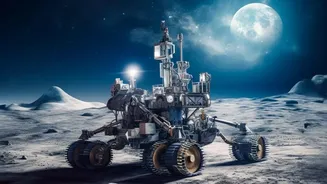
AI's role extends far beyond data analysis on the ground. It is becoming essential for creating autonomous spacecraft capable of making their own decisions. On Mars, the Perseverance rover uses AI to navigate treacherous terrain in real-time, with about 88% of its driving being autonomous. This capability is crucial for deep-space missions where communication delays with Earth can be hours long. Looking ahead, NASA is developing new, radiation-hardened computer chips that will give future spacecraft advanced onboard AI, allowing them to react to unexpected situations without human intervention. AI is also being used to enhance the images we receive. Researchers have developed AI models that can remove atmospheric blurring from ground-based telescope images, making them appear as sharp as those taken from space. Other AI tools can reduce 'noise' in JWST images, effectively doubling the number of distant galaxies detected in some datasets.
The Future Is Autonomous and Predictive
NASA is positioning AI as a core component of its future strategy, launching initiatives like the Genesis Mission to apply machine learning across its vast archives. The goal is to reduce analysis timeframes from years to days, accelerating everything from mission planning to scientific discovery. AI won't just find things we are looking for; it will help us find things we didn't even know to look for by identifying anomalies in data that challenge existing theories. Furthermore, AI will be integral to automating spacecraft systems, monitoring their health, and even planning mission operations. As we venture farther into the solar system with crewed missions to the Moon and Mars, intelligent systems will be vital for ensuring safety and success. AI is not replacing human astronomers but is instead becoming an indispensable tool, augmenting their abilities and opening a new frontier of discovery.