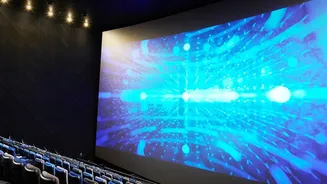







The debate is a familiar one in households across India: should we go to the cinema or wait for it to release on a streaming platform? The answer, increasingly, seems to depend on the film's scale, transforming movie-going into a selective event.
The New Economics of a Night Out
A trip
to the multiplex is no longer a casual outing; it’s a significant financial decision. With ticket prices in metropolitan areas frequently ranging from ₹250 to over ₹800 for standard seats, and premium formats like IMAX costing much more, the expense quickly adds up. A family of four can spend between ₹2,000 and ₹3,000 on tickets, travel, and the notoriously expensive popcorn and drinks. This high cost creates a psychological barrier. Audiences are now asking a crucial question: is this experience worth the price? For many, the answer is only 'yes' if the film offers something that cannot be replicated at home—a larger-than-life visual and auditory experience.
The Comfort and Convenience of OTT
The pandemic drastically accelerated the adoption of Over-The-Top (OTT) streaming services like Netflix, Amazon Prime Video, and Disney+ Hotstar. These platforms have conditioned viewers to expect a steady stream of content, from dramas and comedies to thrillers, to be available at their fingertips for a low monthly fee. This has fundamentally altered audience expectations. A YouGov survey found that 44% of urban Indians cite the ability to stream films online as the top reason for their reduced frequency of cinema visits. Why spend a premium on a theatrical ticket for a dialogue-heavy drama or a mid-budget comedy when it will likely be available to watch at home in a matter of weeks?
What Defines a Theatrical 'Event'?
The films that are successfully drawing audiences to theatres are those positioned as 'events'. These are the visual spectacles—movies like 'Pathaan', 'Jawan', 'Gadar 2', and 'Animal'—that leverage cutting-edge VFX, immersive sound design, and grand-scale storytelling. The experience of watching these films on a giant screen with a state-of-the-art sound system is their primary selling point. It’s an outing that feels distinct from home viewing. Exhibitors and distributors note that these are the true theatrical experiences that cannot be replicated on a television, which justifies the cost and effort of going to a cinema.
A Fork in the Road for Filmmakers
This behavioural shift presents a challenge for the industry. While event films are breaking box office records, smaller, content-driven films are finding it harder to attract theatrical audiences. Pre-pandemic, a small film with good word-of-mouth could earn substantial returns; now, those same types of films often see their box office potential capped. This is forcing a strategic divide: create a massive spectacle for the big screen or produce a story-driven film designed for an OTT release. Streaming platforms have, in a way, become a haven for filmmakers who want to tell unconventional or niche stories without the immense pressure of box office numbers.
The Rise of the Pan-Indian Spectacle
The success of spectacle cinema is closely linked to the pan-Indian film phenomenon. By mounting films on a grand scale with universally appealing action and high production values, filmmakers from regional industries have been able to transcend linguistic and cultural barriers. This strategy has paid off, creating a new formula for blockbuster success that relies on creating a shared cultural moment. Audiences across the country are united by the desire to participate in these massive cinematic events, further cementing the idea that the theatre is now primarily a venue for spectacle.