



Our New Eyes on the Heavens
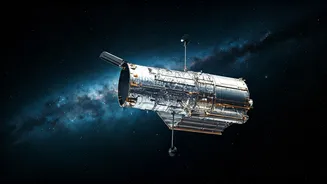
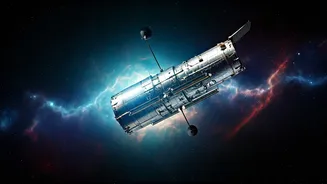
The silence around Saturn has been broken by our most powerful new observatories. In early 2026, NASA released breathtaking new views of the planet, created by combining the powers of the James Webb Space Telescope and the Hubble Space Telescope. Where
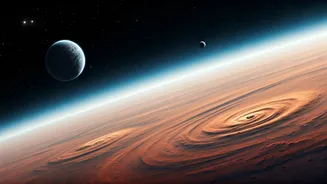
Hubble sees visible light, showing us the familiar butterscotch-coloured bands, Webb peers into the infrared, slicing through the atmospheric haze. This dual approach allows scientists to see the planet in three dimensions, revealing cloud structures and chemical signatures at different depths. These new images have highlighted long-lived jet streams, the lingering remnants of a massive storm from 2011, and new storm activity in the southern hemisphere, turning the planet into a real-time laboratory for extreme weather.
The Incredible Shrinking Rings
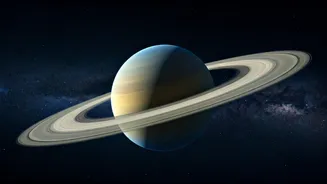
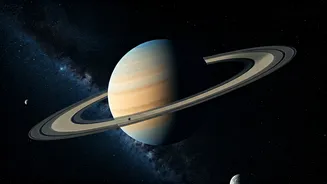
Part of Saturn's renewed appeal is a touch of cosmic drama: its iconic rings are disappearing. From our perspective on Earth, the rings are becoming vanishingly thin. Due to Saturn's 26.7-degree tilt, we see the rings open up and close over its 29-year orbit. In 2025, we will see them almost perfectly edge-on, making them a nearly invisible line in most backyard telescopes. This celestial alignment offers a rare scientific opportunity, but it also creates a visual spectacle of a 'naked' Saturn in the sky. Beyond this line-of-sight illusion, however, is a more permanent demise. Scientists have confirmed that a process of 'ring rain' is pulling material from the rings into the planet's atmosphere. While they won't vanish in our lifetime, the rings we see today are a temporary feature, estimated to be gone in a few hundred million years.
A Growing Family of Moons
It’s not just the planet itself that's providing new surprises. Saturn's family of moons keeps growing at an astonishing rate. In March 2026, astronomers announced the discovery of 11 new moons, bringing the planet's total to a staggering 285. This cemented its status as the 'moon king' of our solar system, far surpassing Jupiter's count of 101. These new additions are small, mostly just a few kilometres across, and orbit far from the planet. They are faint and difficult to spot, discovered through painstaking analysis of images from powerful ground-based telescopes. Each new discovery helps astronomers piece together the violent history of the Saturnian system, suggesting these tiny moons are likely fragments of larger bodies that were captured or shattered long ago.
The Dragonfly Descends on Titan
Perhaps the most exciting chapter in Saturn's new story is a mission that's still to come. NASA's Dragonfly mission is preparing for its launch in July 2028. This is not a traditional rover or orbiter; Dragonfly is a car-sized, nuclear-powered quadcopter designed to fly through the dense atmosphere of Saturn's largest moon, Titan. After arriving in 2034, it will hop from location to location, exploring a world with liquid methane lakes and dunes of organic sand. The mission's primary goal is to study prebiotic chemistry—the complex organic molecules that could be precursors to life. Titan's environment is seen as a natural laboratory for understanding how life may have arisen on Earth. As the spacecraft undergoes its final, grueling tests on Earth, the anticipation for this unprecedented mission continues to build.