






Cosmic Fingerprinting
How do you study the air of a planet you can never visit? Scientists use a clever technique called transit spectroscopy. When an exoplanet passes in front of its host star from our point of view, a tiny fraction of the starlight filters through the planet's
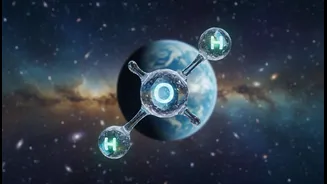
atmosphere. By capturing this light, powerful instruments like those on the James Webb Space Telescope (JWST) can analyze its chemical makeup. Different molecules absorb light at specific wavelengths, creating a unique "fingerprint" or barcode in the light spectrum. This allows astronomers to identify gases like water vapor, methane, and carbon dioxide from trillions of kilometers away, offering a vital glimpse into the conditions on these alien worlds.
Beyond Just Finding Water
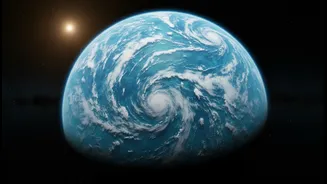
For a long time, the holy grail was simply finding water vapor. And we have. JWST has confirmed water in the atmospheres of multiple exoplanets, from gas giants like WASP-18 b to smaller, exotic "sub-Neptunes" and even 'steam worlds' like GJ 9827 d. But the latest breakthroughs go a step further. The focus is shifting from just detecting water to understanding its behavior. A recent major discovery was the first-ever detection of an atmosphere around a rocky, Earth-like planet called LHS 1140 b, which sits squarely in its star's habitable zone — the region where temperatures could allow liquid water to exist on the surface. This is a landmark achievement because an atmosphere is crucial for regulating climate and shielding a planet, making surface water possible.
The Search for a Dynamic Climate
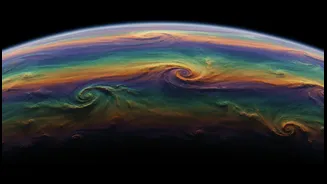
The presence of an atmosphere and water vapor are key pieces of the puzzle, but they don't automatically mean a planet is habitable. The real game-changer is evidence of a water cycle. This means water is not just a static gas but is actively moving between the surface and the atmosphere, potentially creating clouds, weather, and stable climates. This is where the concept of the geologic carbon cycle becomes critical. On Earth, this water-driven process exchanges carbon between the atmosphere, oceans, and rocks, acting as a planetary thermostat over millions of years. New research suggests that planets without enough water can't maintain this balancing act, leading to runaway greenhouse effects like the one that turned Venus into a scorching wasteland. Finding a world with not just water, but an active climate system, is the next frontier.
New Worlds, New Questions
These discoveries are challenging our old assumptions. For instance, astronomers found water vapor in the inner, rocky-planet-forming zone of a young star system, PDS 70, suggesting that the building blocks for watery worlds might be common from the very beginning. This supports theories that water is a natural byproduct of planet formation itself. Other findings have been more surprising. The atmosphere of the exoplanet TOI-421 b, for example, had different chemical ratios than expected, forcing scientists to rethink their models of how such planets form and evolve. Each new atmospheric reading provides not just answers, but a fresh set of questions that refine the search for life. It's a sign that we are moving from simply cataloging planets to truly understanding them as individual, complex worlds.